
Design
Open Plan Kitchen Extension Ideas for London Homes
The open plan kitchen-diner-living space is the defining ambition of London's ground-floor extensions. Here is how to design one that actually works.
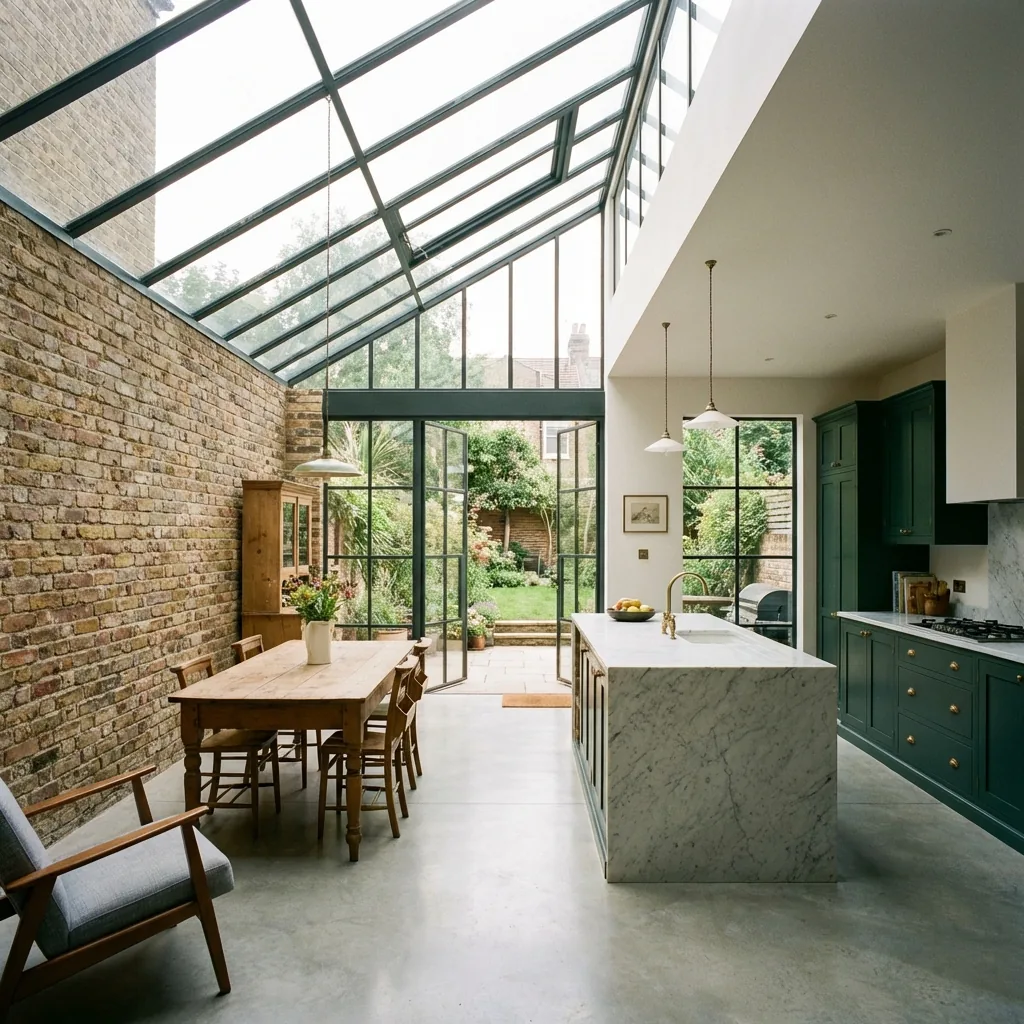
The open plan kitchen extension has become the single most popular residential project in London. The ambition is consistent: take the dark, narrow ground floor of a Victorian or Edwardian terrace and transform it into a single generous space — kitchen, dining, and living — that opens directly onto the garden through full-width glazing.
The idea is simple. Getting the design right is less so. The difference between an extension that transforms how a family lives and one that produces a cavernous, echoey room with nowhere comfortable to sit comes down to the decisions made before construction starts. This guide covers the layout principles, zoning techniques, structural considerations, and design details that make the difference.
Why Open Plan Works in London Terraces
London's Victorian and Edwardian terraces were designed around a fundamentally different domestic model: small rooms separated by corridors and walls, with a scullery kitchen tucked at the back and a formal parlour at the front. The ground floor plan was rarely wider than five metres. The result, by contemporary standards, is a series of dark, disconnected rooms that feel smaller than they are.
An open plan extension addresses this by removing the internal walls between the original kitchen and dining room (and sometimes the reception room beyond), extending the footprint into the garden, and replacing the solid rear wall with glazing. The effect is transformative: one continuous space with natural light reaching from front to back, a kitchen that faces the garden instead of a yard wall, and a dining table positioned where the family naturally gathers.
The Starting Point: Plan Before Elevation
The most common mistake in extension design is starting with the look — the doors, the materials, the roof — before resolving the plan. The plan is everything. It determines how the space feels, how the kitchen functions, where the dining table sits, whether there is a comfortable place to read a book while someone else cooks, and whether the route from the front door to the garden makes sense.
Before any aesthetic decisions, the plan needs to resolve four questions: where is the kitchen? Where is the dining table? Where do people sit? And how do they move between these zones and the rest of the house?
Layout Options
The right layout depends on the width and depth of the house, whether the side return is being incorporated, and how much garden you are prepared to lose. But most London open plan kitchen extensions fall into one of four configurations.
The Kitchen-Diner
The simplest and most common arrangement. The kitchen runs along one or both side walls, with the dining table positioned centrally or near the rear glazing. An island separates cooking from eating. This works well in extensions of 3–4 metres depth on houses 4.5–5.5 metres wide. The existing reception room at the front of the house remains separate, providing a quieter living space.
The Kitchen-Diner-Living Room
A more ambitious version that removes the wall between the original dining room and reception room as well, creating a single space running from the front window to the rear garden. The kitchen sits at the back, the dining table in the middle, and a living area with sofa and television occupies the original front room. This produces a dramatic sense of space and light but sacrifices the separate living room — a trade-off that suits some families and not others.
The Wraparound with Side Return
On a Victorian terrace with a rear outrigger, incorporating the side return adds 1–1.5 metres of width to the kitchen zone. The side return typically becomes the main kitchen run — a long worktop along the boundary wall with a rooflight above — while the rear extension provides the dining and living space. The wraparound layout produces the most generous proportions and the best natural light, because it introduces light from the side as well as the rear and above.
The Broken Plan
A more recent evolution. Instead of removing every wall, broken plan retains partial walls, half-height dividers, or sliding screens to create a space that is open but not entirely exposed. A half-wall behind the sofa, a glazed screen beside the kitchen, or a sliding pocket door between dining and living areas allows the space to be opened up or closed down depending on the moment. This approach is worth considering if you want the spatial generosity of open plan but also value the ability to contain noise, cooking smells, or children's television programmes.
Common Layouts at a Glance
| Kitchen-Diner | Most popular. Kitchen along side walls, island separates cooking from dining. Front room stays separate. |
| Kitchen-Diner-Living | Full ground floor open. Front-to-back flow. No separate living room. |
| Wraparound + Side Return | Side return becomes kitchen run. Best light and proportions. Needs boundary wall agreement. |
| Broken Plan | Partial walls, sliding screens, or half-height dividers. Open feeling with acoustic separation. |
The Island
The kitchen island is the fulcrum of an open plan extension. It separates the kitchen from the rest of the room, provides additional worktop and storage, accommodates the hob or sink (or both), and often doubles as a breakfast bar. In a London terrace where the house width is typically 4.5–5.5 metres, the island needs to be carefully sized.
A well-proportioned island in a standard terrace is around 1800mm long and 1000mm deep. Anything longer risks blocking the natural circulation routes; anything deeper makes it hard to reach the centre of the worktop. The critical dimension is the gap between the island and the kitchen units behind it — a minimum of 900mm is needed for one person to work comfortably; 1100–1200mm is better if two people will be in the kitchen at the same time, or if appliance doors need to open into the aisle.
The Structural Opening
In almost every London terrace extension, the original rear wall is load-bearing. Removing it requires a steel beam — typically a universal beam (UB) — spanning the full width of the opening to carry the first floor joists and roof load above. The beam sits in pockets cut into the party walls at each end, resting on concrete padstones that distribute the load.
The depth of the beam depends on the span and the load. On a typical 5-metre-wide terrace, the beam is usually 200–250mm deep. This matters because the beam depth determines the ceiling height at the junction between the old house and the new extension. A deeper beam means a lower soffit at that point, which can feel oppressive if not handled well.
Good designers resolve this by either exposing the beam as an honest structural element (painted or clad), by building a full-width bulkhead that conceals it and contains downlights, or by using the beam to create a deliberate change in ceiling height — lower over the kitchen, higher in the extension — which reinforces the zoning of the room.
Light Strategy
Natural light in an open plan extension comes from three directions, and using all three is what separates the best extensions from the ordinary ones.
Rear Glazing
Full-width bifold or sliding doors across the rear elevation are the primary light source. Bifolds fold back to create a wide, unobstructed opening; sliders glide behind each other and have thinner frames when closed. Both work well. The choice is partly aesthetic and partly practical — consider how often you will fully open the doors, and how the frames will look on the many days when they are closed.
Rooflights
Rooflights in a flat roof bring diffuse overhead light deep into the plan — reaching areas that the rear glazing alone cannot illuminate. A single large rooflight or a continuous strip running the length of the extension is more effective than several small ones scattered across the roof. Position rooflights over the kitchen zone or over the junction between old and new to wash light down into the heart of the room.
Side Light
Where the side return is incorporated, glazing above the worktop or a full-height glazed panel at the end of the side return brings light from a third direction. This is the light source most often overlooked, and it is the one that makes the biggest difference to how the finished space feels — because it eliminates the darkest corner of the original house.
Lighting Techniques
| Rear glazing (bifolds/sliders) | Primary light and garden connection. Full-width for maximum impact. |
| Rooflights | Overhead diffuse light. Position over kitchen or old/new junction. |
| Side return glazing | Eliminates darkest corner. Often the most transformative single element. |
| Glass upstand / shadow gap | Glazed slot where new roof meets original wall. Washes light down existing brickwork. |
| Internal borrowed light | Glazed panels or fanlights in internal walls to share light with hallways. |
Zoning: Making Open Plan Feel Like Distinct Spaces
The most common criticism of open plan living is that the room feels like a single undifferentiated volume — nowhere feels cosy, nowhere feels contained. Zoning solves this. The goal is to create a space that reads as one room but contains within it three or four distinct areas that each feel purposeful.
The tools for zoning are subtle. A kitchen island defines the boundary of the cooking area. Pendant lights hung low over the dining table make it feel intimate even within a large room. A change in ceiling height — lower over the kitchen, higher in the extension — creates a psychological sense of compression and release. A change in floor material — tiles in the kitchen, timber in the living area — signals the transition between functional zones. And furniture arrangement does much of the work: a sofa positioned with its back to the kitchen creates a living room without a single wall.
The best open plan kitchens use two or three of these techniques in combination. Using all of them risks the room feeling over-designed. Using none of them produces the cavernous, echoey space that gives open plan a bad name.
Flooring
The floor is the largest continuous surface in the room and has an outsized effect on how the space feels. There are two credible approaches.
The first is a single material throughout — large-format porcelain tiles (600 x 600mm or larger) or polished concrete. This creates a seamless, unified space and is the simplest to execute. Porcelain is durable, low-maintenance, and available in finishes that convincingly replicate stone, concrete, or timber. Polished concrete is more industrial in character and requires specialist installation but produces a beautifully monolithic floor.
The second approach uses two materials: stone or porcelain in the kitchen zone and engineered timber in the living and dining zone. The change in material subtly reinforces the zoning without any physical barrier. The junction detail matters — a flush brass or stainless steel threshold strip is cleaner than a standard plastic trim. The two materials should be set at exactly the same finished floor level so the transition is flush.
Underfloor heating works with both approaches and is strongly recommended in an open plan extension. It eliminates the need for radiators that would interrupt the clean wall planes and the rear glazing, and it provides consistent warmth across the full floor area.
Ventilation and Cooking Smells
This is the practical concern that most people underestimate. In a traditional closed kitchen, cooking smells and steam are contained. In an open plan space, they travel. A good extractor hood — rated for the volume of the room, not just the hob — is essential. It should be ducted to the outside, not recirculating, for maximum effectiveness.
Island hobs require either a ceiling-mounted extractor (which needs a duct routed through the flat roof) or a downdraft extractor that rises from within the worktop. Ceiling-mounted extractors are more effective but more visually prominent. Downdraft extractors are sleeker but work less well with tall pots and vigorous steam.
Cross-ventilation from opening rooflights and rear doors provides background air movement. Some homeowners install a partial-height glass screen behind the island hob to direct steam upward toward the extractor and contain splatter.
Acoustics
Hard surfaces — tiles, glazing, plaster, stone — reflect sound. An open plan room full of hard surfaces can feel noisy and echoey, especially with children. The solution is to introduce soft, absorbent materials: an upholstered sofa, a large rug under the dining table, fabric curtains or blinds on the rear doors, and timber or acoustic-rated ceiling panels in areas where the ceiling is exposed.
The structural beam between old and new can also help acoustically — by creating a change in ceiling height, it interrupts the continuous hard surface overhead and reduces the reverberant volume of the space. This is another reason why handling the beam well matters: it serves a spatial, structural, and acoustic purpose simultaneously.
Conservation Areas and Planning
Open plan kitchen extensions are regularly approved in London conservation areas. The internal layout is not a planning consideration — planning officers are concerned with the external appearance of the extension, its impact on neighbours, and whether it preserves or enhances the character of the area.
Rear extensions are generally less contentious than side or front alterations because they are not visible from the public street. However, Permitted Development rights are usually removed in conservation areas, so full planning permission will be required. Material choice, roof form, and the proportion of glazing to solid wall will all be assessed. A pre-application meeting with the local authority is a worthwhile investment on any conservation area project — it gives you an early steer on what the planning officer is likely to support.
Design Details That Matter
The difference between a competent extension and an exceptional one is usually in the details — the small decisions that are easy to overlook but disproportionately affect the quality of the finished space.
Details Worth Getting Right
| Threshold detail | The junction between internal floor and external paving. A flush threshold with drainage channel creates a seamless indoor-outdoor connection. |
| Socket and switch positions | Plan these before the kitchen design is finalised. Floor sockets in the island avoid trailing cables. USB charging sockets at counter height save adapters. |
| Rooflight positioning | Over the kitchen worktop or the old/new junction, not centred in the extension. Light where you need it, not where it happens to fall. |
| Downlight layout | A grid of evenly-spaced downlights looks institutional. Cluster lights over work areas, use pendants over dining, and keep the living zone softer. |
| Boiler relocation | Many Victorian kitchens have a wall-hung boiler that will need to move. Resolve this early — the new position affects the plumbing layout for the whole house. |
| Bifold door stack | When bifolds are fully open, the folded panels stack to one side. Decide which side, and don't put a light switch or socket there. |
| Colour temperature | Warm white (2700K–3000K) for living and dining. Neutral white (3500K–4000K) for the kitchen worktop. Mixing these intentionally reinforces zoning. |
Period Properties: Old and New
On a Victorian or Edwardian terrace, the relationship between the original house and the new extension is an architectural question worth taking seriously. There are two honest approaches.
The first is complementary: London stock brick for the external walls, a roof form that defers to the original, and dark-framed aluminium glazing that reads as a considered addition rather than an imposition. The extension looks like it belongs to the house without pretending to be original.
The second is deliberately contemporary: a clean box of render, zinc cladding, or frameless glazing that contrasts with the original fabric. The new extension makes no attempt to match and instead reads as a distinct intervention — clearly of its own time. This approach is often more appropriate than it sounds, and planning officers in many London boroughs actively prefer it to pastiche.
Both can be excellent; both can be poor. The quality of the design — the proportions, the material junctions, the relationship of scale — matters more than the stylistic choice itself.
Frequently Asked Questions
What is the most popular open plan kitchen extension layout in London?
A rear extension that removes the back wall and combines the original kitchen and dining room into one space. The kitchen runs along the side walls with an island separating it from the dining area, and full-width glazing opens onto the garden.
How do you create zones in an open plan kitchen extension?
Through a combination of a kitchen island, changes in ceiling height, changes in flooring material, pendant lighting over the dining table, and furniture arrangement. The best open plan kitchens use two or three of these techniques together — not all of them.
Do I need to remove a load-bearing wall?
Almost always, yes. The original rear wall of a London terrace is typically load-bearing. A structural engineer will design a steel beam to span the opening and carry the load above. This is one of the most critical structural elements of the project.
What is a side return extension?
The side return is the narrow alley alongside the rear outrigger on many Victorian terraces. Incorporating it into the extension adds 1–1.5 metres of width to the kitchen, transforming the proportions. The side return usually becomes the main kitchen worktop run with a rooflight above.
How big should a kitchen island be?
In a standard London terrace (4.5–5.5m wide), a well-proportioned island is around 1800mm long and 1000mm deep. Allow a minimum of 900mm circulation space on all sides — ideally 1100–1200mm where two people will work simultaneously.
How do I stop cooking smells spreading through the open plan space?
A high-quality extractor hood ducted to outside is essential — rated for the room volume, not just the hob. Position the hob on the boundary wall rather than the island if smells are a concern. Cross-ventilation from opening rooflights helps, and a partial glass screen behind an island hob can direct steam toward the extractor.
What flooring works best in an open plan kitchen extension?
Either a single material throughout (large-format porcelain tiles or polished concrete) for a seamless look, or two materials — tiles in the kitchen zone and engineered timber in the living area — to reinforce the zoning. Underfloor heating is strongly recommended with either approach.
Can I have an open plan kitchen extension in a conservation area?
Yes — rear extensions are regularly approved. Permitted Development rights are usually removed, so full planning permission is required. The external design — materials, roof form, glazing proportion — will be assessed against the character of the conservation area. A pre-application meeting is a worthwhile investment.