
The Eco-Retrofit Guide: Heat Pumps & Insulation
By My Local London Builder Team
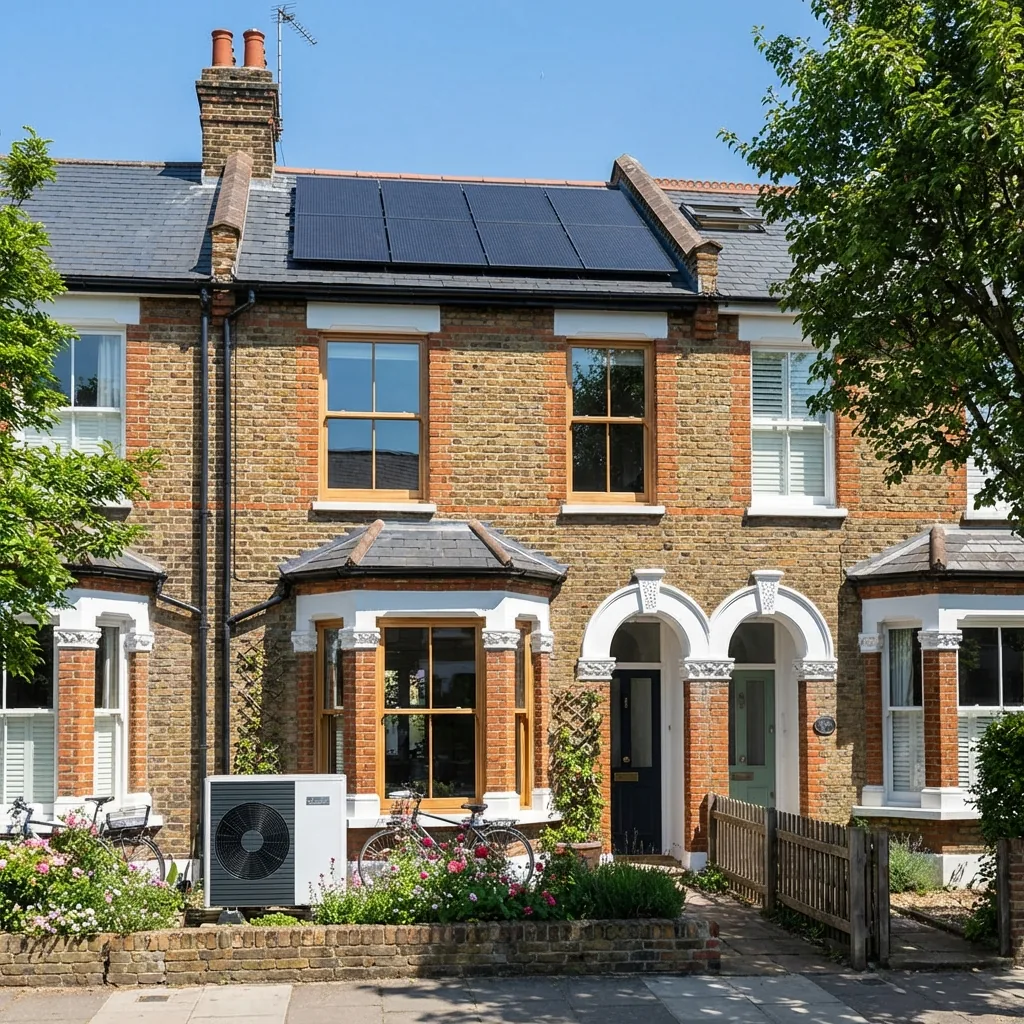
Summary: This deep dive explores the science and strategy of sustainable renovation in London. We explain the "Fabric First" philosophy, detailing how to insulate period properties without causing damp, the role of air tightness, and the reality of installing Air Source Heat Pumps in Victorian homes. This is your roadmap to a warm, future-proofed home.
The conversation around home renovation has shifted. While open-plan kitchens and loft conversions remain popular, a new priority has taken centre stage: energy efficiency. With volatile energy prices and a collective push towards Net Zero, London homeowners are increasingly asking how they can make their draughty Victorian terraces warm, efficient, and sustainable. Our guide to rising energy costs and specifying your extension for 2026 covers the latest Part L requirements in detail.
This process is known as "Deep Retrofit" or "Eco-Retrofitting." It goes beyond simply swapping lightbulbs. It involves fundamentally altering the physics of how your house retains heat and breathes. However, period properties present unique challenges. They were built to "breathe" in a very specific way, and applying modern, impermeable materials incorrectly can lead to catastrophic damp issues.
This guide serves as a technical primer for those considering a deep retrofit, prioritizing building physics and long-term health over quick fixes.
1. The Golden Rule: Fabric First
Before you even look at a brochure for a heat pump or solar panels, you must understand the principle of "Fabric First." It is the cornerstone of sustainable building design.
The concept is simple: Reduce the energy demand of the building before you attempt to decarbonize the energy supply.
Imagine your house is a bucket with holes in it (draughts and uninsulated surfaces). Pouring water in faster (buying a powerful heat pump) is an inefficient way to keep the bucket full. The logical first step is to plug the holes. In construction terms, this means improving the thermal envelope of the building—walls, roof, floor, and windows—to minimize heat loss.
Only once the fabric is efficient does a low-temperature heating system like a heat pump become viable and cost-effective. Installing a heat pump in a leaky, uninsulated house will likely result in higher bills and a cold home.
2. Insulation Strategies for Period Homes
Wall Insulation
Most London housing stock built before 1930 has solid brick walls. These lose heat rapidly compared to modern cavity walls. You have two main options for insulating them:
- External Wall Insulation (EWI): This involves fixing a layer of insulation (rigid foam
or mineral wool) to the outside of the brickwork, then rendering over it.
Pros: Highly effective, no loss of internal floor space, protects the brickwork from weather.
Cons: Changes the appearance of the house. In Conservation Areas or for attractive brick facades, this is often forbidden by planning departments. It also requires detailing changes at eaves and window reveals. - Internal Wall Insulation (IWI): Use of insulated plasterboard or building independent
stud walls filled with wool inside the rooms.
Pros: Maintains the external façade (essential for heritage properties), fits within Permitted Development (usually).
Cons: You lose internal floor area (approx. 50-100mm per wall). It can be disruptive, requiring skirting boards, radiators, and cornices to be moved.
Warning: Managing Moisture
Solid walls need to "breathe" (allow moisture vapor to pass through). If you use impermeable insulation like foil-backed foam internally, you risk trapping moisture within the brickwork, leading to interstitial condensation and rotting joist ends. For period homes, breathability is key.
Roof Insulation
Heat rises, and an uninsulated roof is a major exit point.
- Cold Loft: Insulation is laid between and over the ceiling joists. The loft space remains cold. This is cheap and effective but renders the loft unusable for storage unless raised boarding is installed.
- Warm Roof: Insulation is placed between and under the rafters (the sloping timbers). This brings the loft space inside the thermal envelope, which is essential if you are doing a loft conversion.
Floor Insulation
Suspended timber floors in Victorian houses often have a void underneath with air bricks for ventilation.
This creates significant draughts.
The solution involves lifting the floorboards, suspending insulation nets between the joists, filling
them with mineral wool, and replacing the boards. An airtight membrane is crucial to stop draughts coming up
through the gaps.
3. Windows and Glazing
Original single-glazed sash windows are beautiful but thermally disastrous. They act as "energy holes."
Refurbishment & Draught Proofing: Simply overhauling existing sashes—routing in brush piles and repairing beads—can significantly reduce draughts, even if the glass remains single.
Vacuum Glazing: A cutting-edge technology where the gap between two glass panes is a vacuum rather than gas. This allows the unit to be incredibly thin (around 8mm) while offering the performance of triple glazing. It can often be retrofitted into original timber sashes.
Secondary Glazing: Installing a discreet internal pane behind the primary window. Modern units are slimline and effective for both thermal retention and acoustic insulation.
4. The Motto: Build Tight, Ventilate Right
As you seal up your home to keep heat in, you also stop fresh air from entering. A draughty Victorian house changes is air volume naturally many times an hour. A hermetically sealed eco-home does not.
If you insulate and draft-proof without adding purposeful ventilation, you create a sealed box where humidity from cooking, showering, and breathing accumulates. This leads to poor air quality and black mould.
MVHR (Mechanical Ventilation with Heat Recovery): This is the gold standard solution. A central unit extracts stale, moist air from wet rooms (kitchens, bathrooms) and passes it through a heat exchanger. This heat is transferred to fresh, filtered air drawn from outside, which is then ducted into living rooms and bedrooms. You get fresh air without losing the heat you paid to generate.
5. Low Carbon Heating: Air Source Heat Pumps (ASHP)
Once you have reduced demand (Fabric First), you can look at supply. The gas boiler is being phased out in favor of electrification.
An ASHP looks like an air conditioning unit. It sits outside, takes low-grade heat from the air (even at -10°C), and compresses it to higher temperatures to heat water for your heating system.
The Flow Temperature Difference
Gas boilers heat water to 60°C-70°C. Heat pumps run most efficiently at 35°C-45°C.
Because the water is cooler, you need a larger surface area to emit the same amount of heat into the
room. This is why heat pumps pair perfectly with Underfloor Heating (UFH), which turns the
entire floor into a radiator. If keeping radiators, they may need to be replaced with larger, "oversized"
units (K2 or K3 type).
The Cylinder Requirement
Most heat pumps are "system" boilers, meaning they require a separate hot water cylinder to store water for baths and showers. If you currently have a Combi boiler, you will need to find space for a tank (usually 150-250 litres). Use the airing cupboard or a utility room.
6. Solar PV and Battery Storage
The final piece of the puzzle is generation. Solar Photovoltaic (PV) panels generate electricity during the day. In the UK, peak generation doesn't always match peak usage (evenings). Adding a battery allows you to store that solar energy for use at night.
Even without solar, a battery can be used to charge up from the grid during "off-peak" hours (cheap overnight tariffs) and discharge during the day, reducing your reliance on expensive peak-rate electricity.
Conclusion
Eco-retrofitting is a journey, not a product. It requires a holistic view of the house as a system of moisture, heat, and air movement. By following the Fabric First approach, prioritizing breathable materials, and "sizing" your heating system correct for the new lower demand, you can transform a cold Victorian relic into a comfortable, sustainable home for the future.
Frequently Asked Questions
1. Can I install a heat pump without changing my radiators?
Possibly, but it depends on the heat loss of the room. Because heat pumps run cooler, existing small radiators might not provide enough warmth. A heat loss calculation (room-by-room) is required to determine if radiators need to be upgraded to larger sizes.
2. Is Internal Wall Insulation (IWI) disruptive?
Yes. It requires rooms to be emptied. Skirting boards, cornices, and radiators must be removed. Electrical sockets need to be extended to the new wall face. It is essentially a re-plastering and re-decorating job for the entire room.
3. What is the Boiler Upgrade Scheme?
It is a government initiative that offers a fixed grant towards the upfront cost of installing a heat pump or biomass boiler. It is designed to bridge the gap between the cost of a gas boiler and a low-carbon alternative.
4. How long does a deep retrofit take?
A full "whole house" retrofit including insulation, new windows, plumbing, and electrics is comparable to a major refurbishment, typically taking 4-9 months depending on the size of the property and specification.
5. Does external insulation cause damp?
If installed correctly, no—it actually protects the wall from driving rain. However, detail is critical. Poor detailing around windows or roof overhangs can allow water to track behind the insulation, which can be disastrous.
6. Is a heat pump noisy?
Modern units are very quiet, often comparable to a fridge or a quiet conversation (40-60 decibels). However, placement is important. Planning rules require the unit to be a certain distance from the neighbour's window to prevent noise nuisance.