
The Victorian Side Return extension: Unlocking the "Dead Space"
By My Local London Builder Team | January 25, 2025
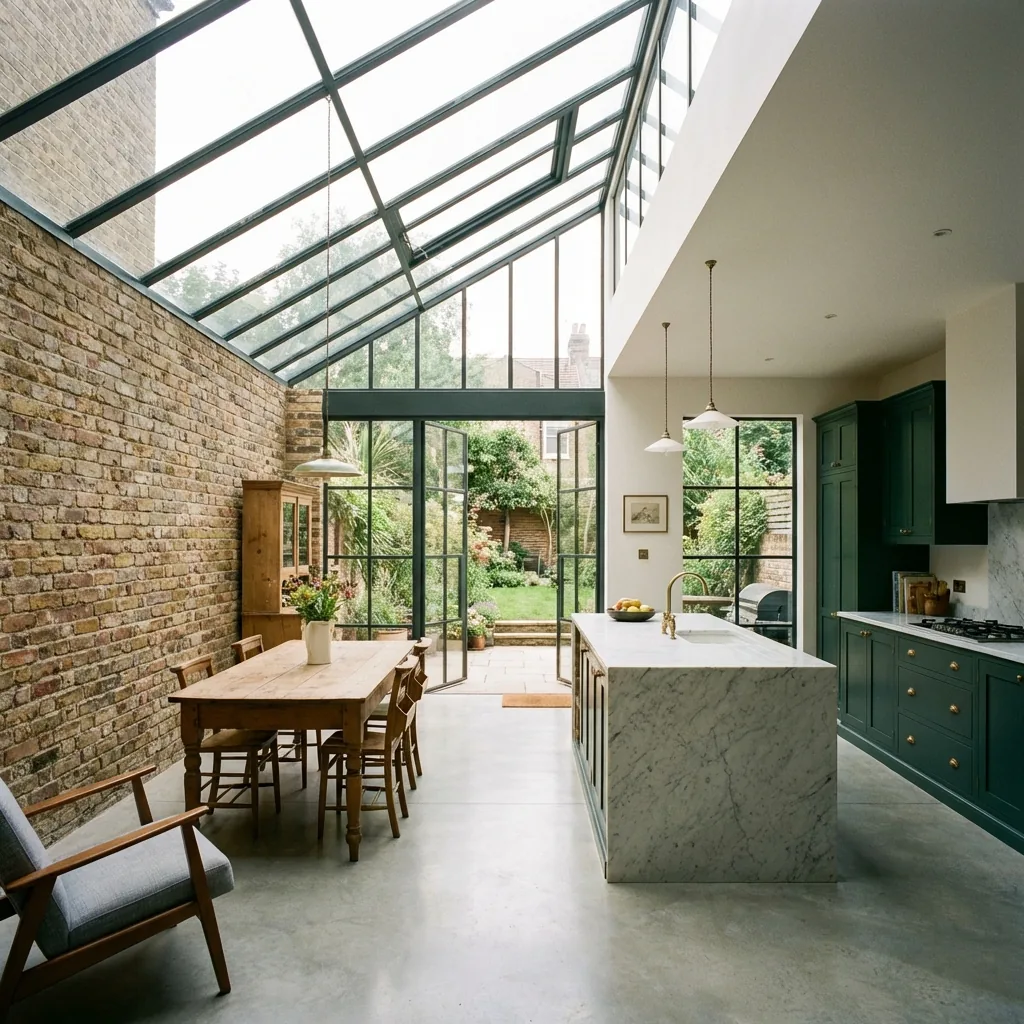
Summary: It is the defining feature of the London terrace: the narrow, damp, unused alleyway running down the side of your kitchen. For 100 years, it was for coal storage and outside loos. Today, it is the golden ticket to a modern family home. This guide dissects the "Side Return Extension"—how to build it, how to permit it, and how to transform a cramped galley into a light-filled heart of the home, without moving house.
If you live in a Victorian terrace in N1, SW6, or SE22, you know the struggle. You have a "double reception" at the front that you rarely use, and a narrow "galley kitchen" at the back where you spend 90% of your time. You are cooking dinner while your guests shout at you from a different room. You are fighting for elbow room to make toast.
The solution is sitting right outside your window. That dark paved alleyway where you keep the recycling bins and a dead potted plant? That is your future dining room.
The Side Return Extension is not just a building project; it is a lifestyle correction. It aligns the Victorian architecture with the way we live today. It is also a smart way of adding value to your home.
The Anatomy of the "Side Infill"
Architecturally, the concept is simple. We knock down the side wall of your existing kitchen. We build a new wall on the boundary line of your neighbour's property. We put a roof over the gap.
The Impact: You might only gain 1.5 meters in width. On paper, that sounds negligible. In reality, it changes everything. A 3-meter wide kitchen feels like a corridor. A 4.5-meter wide kitchen feels like a room. It fits an island. It fits a dining table. It fits a sofa.
The Light Paradox
Homeowners often panic: "If I extend into the side, won't I lose the window? Won't the middle room become a dungeon?"
The opposite is true. If designed with courage, a side return brings more light in.
The secret is the roof. By using a "structural glass" roof or a series of large Velux skylights along the entire length of the side return, you create a 6-meter long lightbox. This captures sunlight from directly above—which is 3x brighter than light from a vertical window. The result is a kitchen that glows.
Planning: The Rules of Engagement
Can you build it without asking the council?
The Good News: Many side returns fall under Permitted Development Rights. If you stick to the rules (single storey, max 4m high, materials matching existing), you can often start without full planning permission. However, the definition of "side" vs "rear" on an L-shaped Victorian house is a legal minefield. Some councils argue the "outrigger" side wall is a "rear" wall. Others disagree.
The Strategy: Always apply for a Certificate of Lawfulness. Do not just start digging. If you live in a Conservation Area (most of Islington/Hackney), you will likely need Full Planning Permission anyway.
The Neighbour Factor (Party Wall)
You cannot build a side return in secret. You are building right up to the line. In fact, the most efficient way to build is to demolish the garden wall and build your new kitchen wall astride the boundary (the "Party Wall").
This triggers the Party Wall Act. Your neighbour will be nervous. They will worry about their light (valid) and their foundations (also valid). You will need to serve notice early. If you want to build on the line, you need their express written consent. If they say no, you have to pull back 50mm and build wholly on your land. That 50mm is painful to lose. Be nice to your neighbours.
Exposed Brick: The London Aesthetic
When we remove the side wall of the kitchen, we have a choice. We can plaster over everything to make it look smooth and new. Or, we can leave the steel beam exposed and paint it dark grey, and leave the old external brickwork exposed inside.
We say: keep the brick. It tells the story of the house. The contrast between the rough, historic London stock brick and the sleek, modern glass roof is what makes these extensions beautiful. It is "perfectly imperfect." Learn more about renovating period properties.
The "Wraparound": Going Big
If you want more than just the side, you can do a "Wraparound." This extends the side return AND extends the rear of the kitchen into the garden.
This creates a massive L-shaped open space. It is the ultimate renovation. However, be warned: Wraparounds almost never fall under Permitted Development. The council views them as "joining a side and a rear extension" which is not allowed under PD. You will need Full Planning Permission, and you will need to prove you aren't stealing too much of the garden.
The Unsexy Stuff: Drains and Steel
We must talk about what lies beneath. That alleyway is not just empty space; it is usually the highway for your drains.
- The Manhole: If there is a manhole in the alley, we have to move it or seal it (with expensive double-sealed covers) inside your new floor.
- The Soil Stack: The big pipe from your toilet usually runs down that outside wall. We can't have a sewage pipe in the middle of your new kitchen island. We have to re-route it. This is noisy, smelly work during The Strip Out phase.
Courage to Commit
A side return is not a cheap "tack on." It is a major structural intervention. We are essentially removing the corner of your house and holding it up with steel.
But the ROI (Return on Investment) is unbeatable. Don't just think about the square footage "on paper." A side return doesn't just add meters; it stops you from having to move to the suburbs. It keeps your children in their schools and you in your community. It allows you to stay in the London you love, in a home that finally fits your life.
Frequently Asked Questions
1. What is a side return extension?
A side return extension involves building into the narrow alleyway (the 'side return') that runs alongside the rear 'outrigger' (kitchen) of a traditional Victorian terrace. It typically adds 1.5 to 2 metres of width to the kitchen, transforming a narrow galley into a wide, open-plan space.
2. Do I need planning permission for a side return?
Often, no. Side return extensions can frequently be built under Permitted Development rights, provided they are single storey, no more than 4m high, and do not extend beyond the side elevation of the original house. Always apply for a Certificate of Lawfulness.
3. Will a side return make my kitchen dark?
This is the biggest myth. By using a structural glass roof or large skylights over the side return area, you actually bring MORE light into the middle of the house than the original window provided. It becomes a light-well.
4. Do I need a Party Wall Agreement?
Yes, absolutely. You are building right up to the boundary line, often excavating for new foundations next to your neighbour's wall. You cannot do this without complying with the Party Wall Act.
5. Can I keep the exposed brick wall?
Yes, and you should. Keeping the original external flank wall exposed as an internal feature is a classic London design move. It adds texture and history to a modern space.
6. How much width does it actually add?
While 1.5 meters sounds small, in a 3-meter wide Victorian kitchen, it represents a 50% increase in width. This is the difference between a galley kitchen and a room that fits a dining table or island.
7. What happens to the soil pipes?
Victorian houses usually have the soil stack (toilet waste) on the side wall. We have to move this. Often we bury it under the new floor or relocate it to the rear. It is a messy job but essential for the clean look.
8. Can I have a wraparound extension?
A wraparound combines a side return with a rear extension. This creates the maximum possible space but almost always requires Full Planning Permission as it exceeds Permitted Development limits.
9. Do I need to underpin the neighbour's wall?
Sometimes. If your new foundations are deeper than your neighbour's shallow Victorian footings (which they often are), you might need to pour concrete under their wall to support it. This requires their special consent.
10. Is it worth losing the side access?
For 99% of Londoners, yes. The side alley is usually a damp dumping ground for bins and old bikes. Trading that 'dead' external space for 'live' internal high-quality kitchen space is the single best trade-off you can make in a terrace.