
Flat Roof Extensions in London — Planning Rules, Building Regulations and Design Considerations
Flat roof extensions are the dominant rear extension form on London properties, particularly on Victorian and Edwardian terraces. This comprehensive guide covers planning rules, Building Regulations requirements, waterproofing systems, rooflights and drainage design, and explains how flat roofs compare to mono-pitched and pitched alternatives. Learn about thermal performance, the critical importance of proper drainage, and how to specify a flat roof extension that will perform reliably for decades.
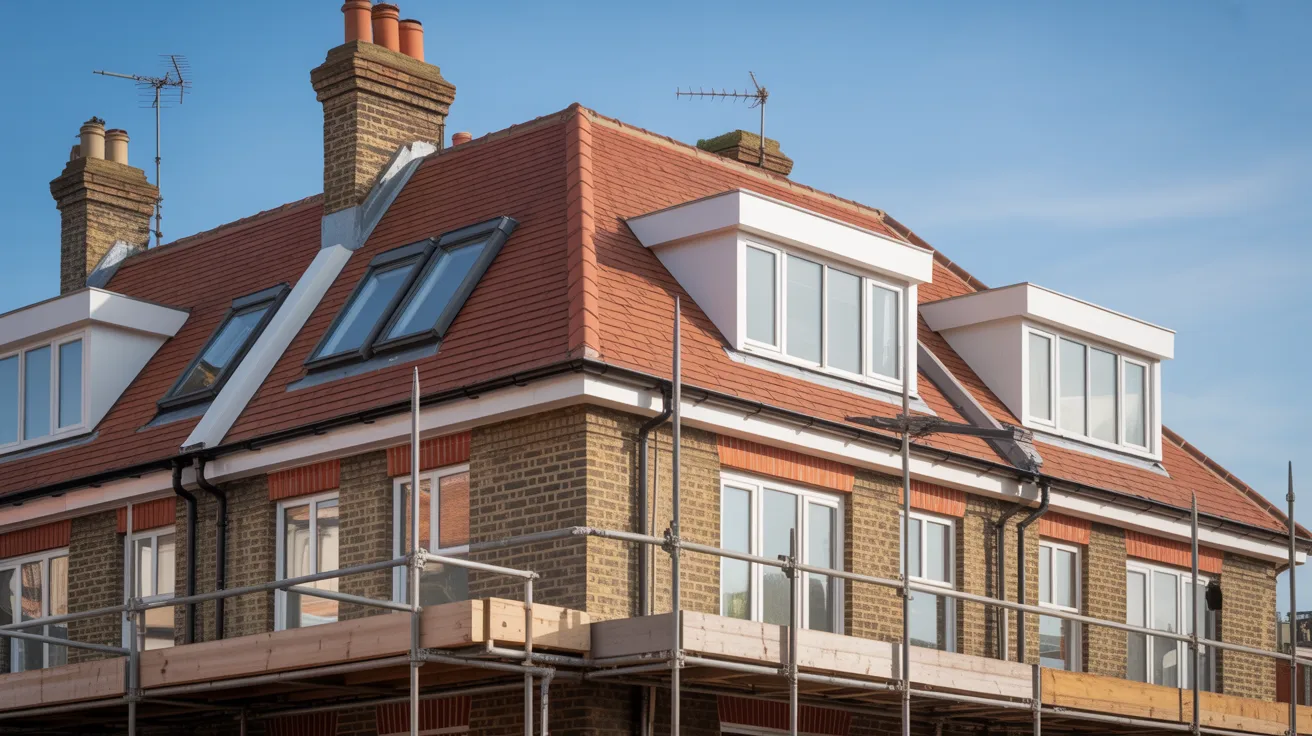
What a Flat Roof Extension Is
A flat roof extension has a near-horizontal roof surface. The word "flat" is somewhat misleading — the roof is not truly flat. Building Regulations require a minimum fall (slope) of 1:80, which is approximately 0.7 degrees, sufficient to allow rainwater to drain toward outlets without pools of standing water forming on the surface. In practical terms, a "flat" roof looks level to the eye, but the structural deck is deliberately angled to achieve drainage.
Flat roof extensions are the most common roof form on rear extensions in London, particularly on terraced properties dating from the Victorian and Edwardian periods (1860–1920). There are several reasons for this dominance. First, the flat roof provides maximum internal head height to the underside of the structure — all the vertical space is usable, whereas a pitched roof creates sloping soffit heights at the sides. Second, flat roofs accept rooflights readily, allowing large glazed areas to be incorporated into the roof plane, bringing overhead daylight into the new space. Third, they are structurally straightforward, using simple beam-and-joist construction that builders understand and can execute reliably. Fourth, they are generally accepted by planning officers in most London boroughs — a well-detailed flat roof extension does not read as incongruous on a period property when the parapet, detailing, and finishes are appropriate.
A flat roof extension is typically constructed from a structural frame — either timber joists or steel beams — spanning between the rear wall of the original house and an external wall at the far end of the extension. The structural depth is typically 300–400mm to accommodate beams and insulation. Above the structure, waterproofing (usually a membrane such as EPDM or GRP) is applied, with rooflights and other penetrations incorporated as required. Below, a plasterboard finish is applied and services (plumbing, wiring) are concealed within or below the structural depth.
Planning Rules for Flat Roof Extensions
A single-storey flat roof rear extension within Permitted Development size limits does not require planning permission, provided Permitted Development rights have not been removed and the property is not in a conservation area or subject to an Article 4 Direction. This is the standard position for a majority of London terraced and semi-detached houses.
The PD limits for a single-storey rear extension are: 3 metres deep on a terraced house, 4 metres on a semi-detached or detached house. The extension must not exceed the eaves height of the original house (the height to which the outer wall of the original house extends before the roof begins). The extension must be set back a minimum of 2 metres from the rear boundary (unless reduced by prior development or specific local rules). The roof must not project above the roof ridge of the original house.
For a flat roof extension, the key requirement is that the roof (the highest point, before any parapet) does not exceed the eaves height. A parapet — a low wall rising above the roof surface — is common on contemporary flat roof extensions and is visually acceptable. The parapet is considered part of the building envelope, not an increase in roof height, so it does not breach the eaves height constraint.
Flat roof extensions are generally acceptable to planning officers in most London boroughs. They are the dominant rear extension form and do not read as incongruous on period properties when detailed appropriately. However, in conservation areas, the specific detailing — the parapet, the rooflight specification, the rear glazing, and materials — may be subject to local conservation area guidance or policies. Some conservation areas express a preference for pitched roofs; many do not. The key is to check your conservation area appraisal (a document published by each local authority) before assuming flat roofs are acceptable.
Rooflights on a flat roof are permitted under Class C of the Town and Country Planning (General Permitted Development) Order. Rooflights are permitted provided they do not project more than 150mm above the roof surface. This applies to rooflights on the flat extension roof as well as any rooflights on the roof of the original house. Opening rooflights (which can be opened for ventilation) are permitted under the same rule.
Building Regulations for a Flat Roof Extension
Building Regulations approval is required for all extensions, regardless of whether planning permission is needed. This is a separate legal requirement. Your local authority's Building Control service (or an approved inspector) will assess the extension against Building Regulations and issue a completion certificate once the works are finished and inspected.
Thermal Performance (Part L): A flat roof must meet minimum thermal performance (U-value) requirements. As of 2026, the requirement for new roofs in England is a U-value of 0.15 W/m²K. This is a rigorous standard and requires careful specification of insulation. Warm roof construction (insulation placed above the structural deck) is the standard approach. In this method, the structural deck is kept warm by the insulation, avoiding the condensation risk of cold roof construction (where insulation sits below the deck, leaving the structural timbers or steel exposed to cold and potentially subject to interstitial condensation).
Structural Adequacy: The roof structure must be designed by a structural engineer to carry all loads imposed: dead load (the weight of the roof build-up — structure, insulation, waterproofing, finishes), imposed load (the weight of snow, or design load for maintenance access), and wind uplift (the force exerted by wind trying to lift the roof away from the building). A structural engineer will produce calculations and a design drawing that Building Control will assess.
Drainage: Building Regulations require adequate drainage of the roof surface. A minimum fall of 1:80 is specified; in practice, a steeper fall (1:40 or more) is preferable because it provides a margin against deflection of the structure under load, which could reduce the effective fall and cause pooling. Outlets (downpipes) must be sized correctly to handle the maximum rainfall expected; overflow outlets must be provided at a slightly higher level to prevent water ponding if the primary drains become blocked. The drainage design must be shown on the Building Regulations drawings.
Fire Resistance: Elements adjacent to boundaries (shared walls with neighbours) may require fire-resistant construction. If your extension has a party wall with a neighbour's property, the roof structure may be required to be fire-resistant. This is typically achieved through specifying fire-rated materials (fibre cement board, rather than timber, for example, or applying fire-resistant coatings).
Waterproofing Systems — The Main Options
The waterproofing system is the most critical element of a flat roof. Poor waterproofing is the leading cause of flat roof failure. There are several established systems, each with different characteristics, durability profiles, and suitability for different roof geometries.
EPDM (Ethylene Propylene Diene Monomer): EPDM is a synthetic rubber membrane, widely regarded as the most durable flat roof waterproofing for domestic extensions. It has a lifespan of 40–50 years when properly installed, significantly longer than most alternatives. EPDM can be laid in large sheets with minimal joins (which are the most vulnerable points in any membrane), reducing the number of seams. It accommodates thermal movement well — as the roof expands and contracts with temperature changes, EPDM flexes with it. It is relatively forgiving to install if site conditions are wet. The main disadvantages are cost (EPDM is more expensive than some alternatives) and the need for specialist installers with EPDM experience.
GRP (Glass-Reinforced Plastic / Fibreglass): GRP is a rigid laminated system applied over the roof deck, built up in layers and cured chemically to form a monolithic waterproof surface. GRP has excellent durability (25–40 years is typical) and creates a seamless surface within each application area — there are no joins to fail. It is resistant to foot traffic and standing water. However, GRP is rigid and cannot accommodate significant thermal movement, so it is not suitable for roofs with movement joints or where deflection under load is a concern. It also requires careful installation — the resin is toxic during application and the process cannot be rushed.
Single-Ply Membrane (TPO, PVC, or Similar): Single-ply membranes are synthetic materials available in rolls, laid over the deck and mechanically fastened or adhered. They are lightweight, flexible, and fast to install. Durability is good (20–30 years is typical). Single-ply membranes are available in a range of colours and finishes, offering design flexibility. They are increasingly common on domestic extensions because of their speed of installation and cost-effectiveness. The main limitation is that lap seams between adjacent sheets are the weak point; careful specification and skilled installation are required to ensure the seams remain watertight long-term.
Built-Up Felt: Three layers of bitumen-bonded felt, applied over the deck and torched or mopped with hot bitumen. This is a traditional system still specified on some works, but it is less durable than modern alternatives (10–15 years is typical) and has largely been superseded by EPDM, GRP, and single-ply membranes.
Green / Sedum Roof: A living roof system incorporating a waterproof base membrane, a drainage layer, a filter cloth, and a growing medium (typically a shallow soil) in which sedum plants (hardy, low-growing plants) are established. A sedum roof reduces rainwater runoff (the plants and growing medium absorb rainfall and release it slowly), provides some insulation benefit, and is increasingly favoured in London boroughs for environmental reasons and in conservation areas for aesthetic reasons. The main consideration is the weight — living roofs impose additional dead load on the structure, so a structural engineer's assessment is essential. Once established, a sedum roof requires minimal maintenance (occasional weeding). The upfront cost is higher than a conventional membrane, but the longevity and environmental benefit often justify it.
Rooflights — Getting the Specification Right
Rooflights are one of the most transformative elements of a flat roof extension. They bring overhead daylight into the space in a way that rear glazing (vertical windows) alone cannot provide. However, rooflights need careful specification to deliver genuine benefit rather than appearing as isolated pools of light.
A well-specified rooflight system — larger format units, double or triple glazed with low-E glass for thermal performance, positioned to illuminate the entire depth of the extension — dramatically transforms the quality of light in a rear extension. A single small rooflight, by contrast, adds only a token amount of light and can appear disproportionate to its usefulness.
Fixed vs Opening: Fixed rooflights allow light in but do not provide ventilation. Opening rooflights (either manually operated or motorised) provide both daylight and ventilation. Under Part F (Ventilation) of Building Regulations, kitchens and bathrooms require mechanical ventilation or openable windows. An opening rooflight in a kitchen or bathroom can satisfy this requirement, eliminating the need for an extraction fan and associated ductwork — a significant architectural simplification.
Position: The position of rooflights within the roof plane determines how effectively they illuminate the space. Rooflights positioned close to the rear edge of the extension provide direct sky light and are visible from the garden. Rooflights positioned at mid-span, running lengthwise along the extension, illuminate the centre of the room and create a sense of overhead light across the entire space. The best solution often combines both — a strip of rooflights along the rear edge for direct sky light, and possibly one or more at mid-span for overall illumination.
The Glass-to-Wall Strip: One of the most effective light details in a rear extension is a structural glazing strip at the junction between the flat extension roof and the original house rear wall. This is a band of glass, typically 200–400mm wide, running the full width of the extension, positioned at the roofline where the extension meets the house. This strip brings daylight along the entire back wall of the original house, dramatically improving light quality in adjacent rooms (a kitchen or dining room, for example). The glass transmits light into the original building that would otherwise be blocked by the extension roof. This detail requires careful structural design — the glass is supported on steel or reinforced concrete beams — but the architectural benefit is disproportionate to the complexity.
Drainage — A Detail That Determines Performance
Poor drainage is the most common cause of flat roof failure and premature deterioration. The importance of correct drainage cannot be overstated — it is the single most critical factor in flat roof longevity.
Rainwater falling on a flat roof must drain toward outlets (downpipes) at the lowest points of the roof. This requires the roof structure to be designed with a consistent fall toward the outlets. For a rectangular extension, this is straightforward — the deck slopes uniformly toward one edge or a central line. For a wider or more complex extension, designing the fall so that all water reaches outlets without ponding requires careful structural planning. A structural engineer will produce a fall diagram showing the designed slopes and outlet positions. The roof deck must be constructed to match this diagram precisely — if the structure deflects under load and the fall is reduced, water may pond on the surface, adding weight, which causes further deflection, which worsens the ponding — a vicious cycle.
Outlets must be sized correctly for the rainfall expected. The building regulations require calculations showing that the outlet capacity exceeds the expected rainfall intensity. For a small extension on a London property, this is typically straightforward, but it must be done.
Overflow outlets are essential. These are a second set of outlets positioned slightly higher than the primary drains. If the primary drain becomes blocked (by leaves, debris, or other obstructions), water will rise until it reaches the overflow level and drain away. Without overflows, blocked primary drains can cause water to pond and eventually overflow the parapet edge or find its way into the building. Building Regulations require overflow provisions for all flat roofs; specifying two independent downpipe systems rather than a single downpipe is the most robust solution.
Internal drainage (concealing downpipes within the structure, so they exit through the interior of the original house) produces a cleaner architectural result than exposed external downpipes visible on the garden side of the extension. However, internal drainage requires careful detailing at the connections between the roof and the internal pipes — these are potential leak points. Many architects and builders prefer external downpipes because they eliminate the risk of internal leaks, even though they are less elegant architecturally.
Flat Roof vs Pitched Alternatives
While the flat roof is the dominant rear extension form in London, it is not always the best choice. In some contexts, a mono-pitched roof (a sloped, lean-to-style roof) or a pitched roof matching the original house's profile may be more appropriate or more likely to be approved.
| Aspect | Flat Roof | Mono-Pitched (Lean-To) | Pitched (Matching Original) |
|---|---|---|---|
| Planning Simplicity | Simple; widely accepted in most boroughs and conservation areas if well-detailed | Generally acceptable; reads as a contemporary lean-to; some conservation areas prefer this over flat | Often preferred in conservation areas; mimics original roof form; may be required in some areas |
| Rooflight Options | Excellent; rooflights integrate seamlessly into flat roof plane; large glazed areas possible | Good; skylights can be positioned along the pitch; effective but less flexible than flat roof | Limited; rooflights must fit within the pitch geometry; fewer large-format options available |
| Internal Head Height | Maximised; full floor-to-underside-of-roof height available throughout | Reduces toward the rear; lower eaves at the far end of the extension | Reduces toward eaves; lower at the sides; dependent on pitch angle |
| Maintenance | Membrane waterproofing requires inspection every 5 years; outlets must be kept clear | Tile or slate; low maintenance; gutters and outlets must be cleared regularly | Tile or slate; low maintenance; gutters and outlets must be cleared regularly |
| Character | Contemporary; clean horizontal lines; modern aesthetic; sits neutrally behind period houses | Contemporary; lean-to profile; visually lighter than pitched; transitional aesthetic | Traditional; matches original roof form; continuous roofline; blends with period character |
| Conservation Area Suitability | Many conservation areas accept flat roofs; check local appraisal; detailing is critical | Often preferred over flat in some conservation areas; reads as lighter; good compromise | Strongly preferred in most conservation areas; respects period character; likely to be approved |
| Typical Use on London Terraces | Dominant form; used on majority of rear extensions; standard approach on Victorian/Edwardian homes | Less common; used where planning prefers contemporary but owners want pitched aesthetic | Less common on rear extensions; more common on side extensions matching original roof pitch |
A mono-pitched (lean-to) roof is a sloped, single-pitch roof similar in appearance to a greenhouse or garden room. It provides good visual lightness and can be preferred in some conservation areas where planners view it as transitional between flat and fully pitched. A mono-pitched roof accepts skylights readily and provides internal head height variation — full height at the front (where it meets the original house) and lower at the rear.
A pitched roof that matches the original house's pitch and tile specification is the most traditional solution and is strongly preferred in some conservation areas. It maintains visual continuity with the original building and blends seamlessly with period properties. However, a pitched roof reduces internal usable height, particularly toward the rear of the extension, and roof geometry limits rooflight options.
The flat roof remains the standard choice for rear extensions in London because it maximises internal space, accepts rooflights readily, and is visually neutral. But if your property is in a conservation area or if local guidance expresses a preference for alternative roof forms, consult your conservation area appraisal and, if needed, discuss the roof form with your local planning authority before finalising the design.
Parapet or No Parapet?
A parapet is a low wall that projects above the roof surface at the edge of the extension — typically 300–600mm high. Parapets are common on contemporary flat roof extensions and create a clean, horizontal roofline when viewed from the garden. The parapet conceals the roof membrane, rooflights, and mechanical equipment (water tanks, heat pump units, etc.) from view, presenting a finished architectural profile to the rear garden.
An alternative is to finish the roof without a parapet — the roof surface meets the external wall at the fascia level. This is simpler to construct (fewer elements) and lower on maintenance (one fewer element to detail and maintain). Visually, it creates a lighter profile, though it exposes the rooflight frames and any other roof equipment to view from the garden.
In conservation areas, parapets can be perceived as contemporary and out of character with period houses. Some conservation area appraisals encourage parapets to be avoided or minimised on extensions to period properties. Check your local guidance. If a parapet is used, careful detailing of materials (brick, stone coping, etc. matching the original house) is important for it to sit well on a period property.
The flat roof is the dominant rear extension form in London for good reason — it is structurally straightforward, accepts rooflights readily, and sits neutrally behind the period character of a Victorian or Edwardian terrace. But the detail is everything: proper fall, reliable drainage, durable waterproofing, and skilled installation are non-negotiable.
Frequently Asked Questions
Do I need planning permission for a flat roof extension?
Not necessarily. A single-storey rear flat roof extension within Permitted Development size limits (3m for terraces, 4m for semis) does not require planning permission, provided PD rights have not been removed by Article 4 or conservation area restrictions. Building Regulations approval is always required.
How long does a flat roof last?
Durability depends on the waterproofing system: EPDM typically 40–50 years; GRP 25–40 years; single-ply membranes 20–30 years; traditional felt 10–15 years. Proper installation, correct fall, and regular maintenance of drainage outlets are the primary determinants of longevity.
Can I add rooflights to a flat roof extension?
Yes. Rooflights on a flat roof are Permitted Development under Class C provided they project no more than 150mm above the roof surface. Opening rooflights also provide ventilation, which may be required under Part F of Building Regulations for kitchens and bathrooms.
What is the minimum fall for a flat roof?
1:80 (approximately 0.7 degrees) is the minimum required by Building Regulations. In practice, a fall of 1:40 or steeper is preferable to provide margin against structural deflection and ponding.
Is a flat roof suitable for a conservation area?
In many cases yes. Flat roof rear extensions are common in London conservation areas and are generally acceptable if well-detailed. Check your specific conservation area appraisal for local guidance on materials and detailing.
What is the best waterproofing system for a flat roof extension?
EPDM is widely regarded as the most durable domestic flat roof system (40–50 years lifespan). GRP is excellent for simple, rigid geometry. Single-ply membranes offer versatility and speed of installation. The right choice depends on roof geometry, size, and overall specification.
What is a warm roof?
A construction method where the insulation is placed above the structural deck, keeping the deck warm and avoiding the condensation risk of cold roof construction (insulation below the deck). Warm roof construction is the standard approach for new flat roofs under current Building Regulations.
What is a glass-to-wall strip?
A narrow band of structural glazing running horizontally where the flat extension roof meets the original house's rear wall. It allows daylight to enter along the full length of the back wall, dramatically improving the quality of light in the new space and adjacent rooms in the original house.
Can I use a flat roof as a roof terrace?
Potentially, but it requires planning permission (not Permitted Development) and structural consideration. The structure must carry pedestrian loading; the waterproofing must be robust; and overlooking implications will be assessed. A designated roof terrace is a material change of use and is not automatically allowed.
Do I need Building Regulations for a flat roof extension?
Yes, always. Building Regulations approval is required regardless of planning permission. Key areas: structural adequacy, thermal performance (U-value 0.15 W/m²K), adequate drainage with overflow provisions, and fire resistance at boundaries.
References and Further Reading
- GOV.UK: Building Regulations Approval
- Planning Portal: Permitted Development Rights
- Historic England: Conservation Areas Guidance
- Approved Document C: Moisture