
Single-Storey Rear Extension Ideas for London Homes
By My Local London Builder Team | March 2026
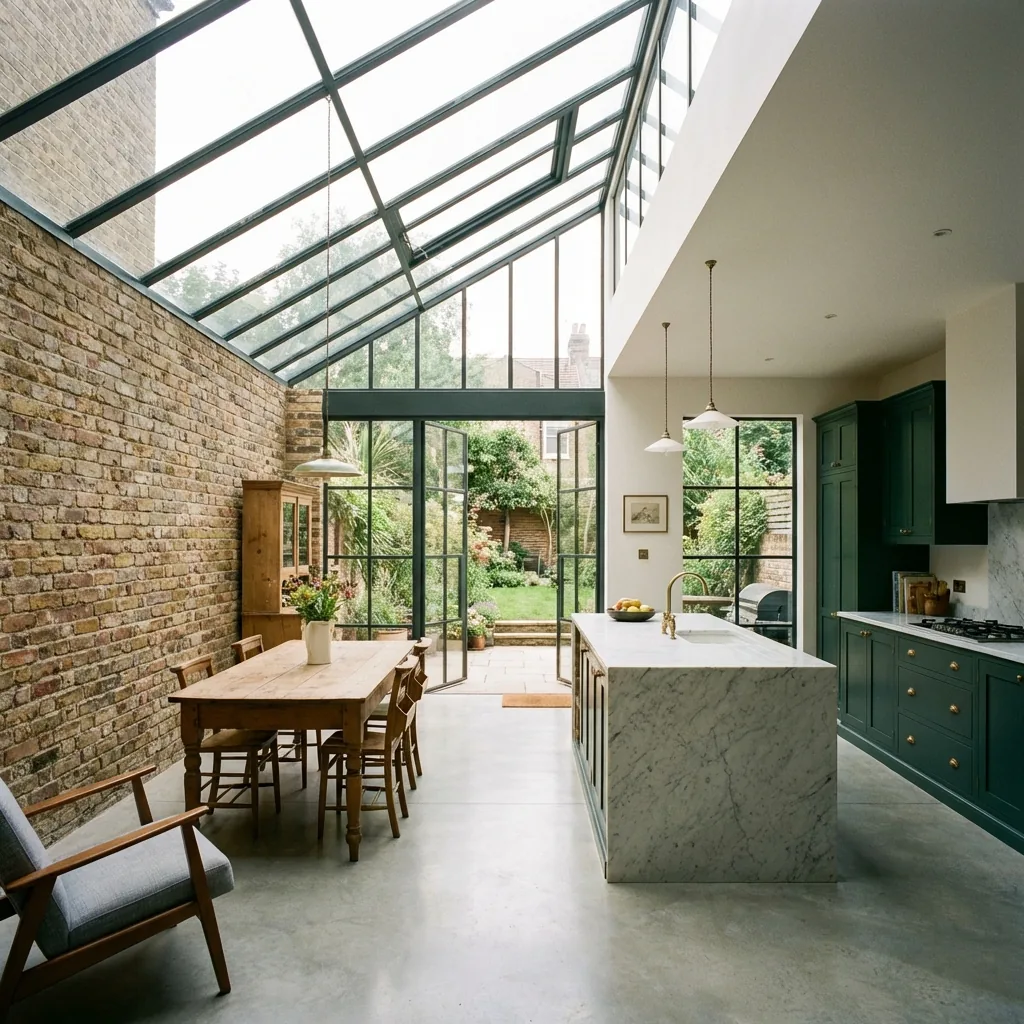
Summary: The single-storey rear extension has become the defining home improvement of London's Victorian terraces — and for good reason. It solves the problem that almost every terrace shares: a cramped, disconnected ground floor where the kitchen, dining room, and garden refuse to talk to each other. But the gap between a good extension and a great one is wider than most people expect. This guide explores the ideas, configurations, and design details that make the difference.
Start With the Plan, Not the Elevation
Most people begin thinking about their extension by picturing what it will look like from the garden — the glazing, the roofline, the materials. That instinct is understandable, but it is the wrong starting point. The design decisions that most determine whether an extension transforms how you live are all about plan: how the new space connects to the existing rooms, where the kitchen sits in relation to the dining area, how you move from inside to outside, and where natural light enters and at what angle.
An extension that is visually beautiful from the garden but produces an awkward internal plan — a dead-end kitchen, a dining area in permanent shadow, a circulation route that cuts through the cooking zone — will frustrate you every day. An extension with a less photogenic exterior but a generous, well-organised interior will earn its place in the house for decades. Start with the plan.
The Open-Plan Kitchen-Diner: Still the Right Idea
The open-plan ground floor has been the dominant spatial idea in London home extensions for twenty years, and it remains the right answer for the majority of terraced properties because it directly addresses the most persistent problem: the Victorian terrace was designed as a sequence of small, cellular rooms, and none of those rooms — individually — is big enough for the way families live today.
By extending to the rear, removing the wall between the existing kitchen and the room in front of it, and treating the new floor area as part of a single open space, the ground floor is transformed. The kitchen gains working area and natural light from the rear. The dining area gains connection to the garden. The cooking parent is no longer isolated from the family. The extension earns its footprint.
What varies between the best and worst examples of this idea is not the concept — it is the execution. The quality of the kitchen design, the position of the island relative to the cooking zone, the relationship between the dining table and the glazed doors, the way the new floor level relates to the garden level: these details collectively determine whether the space is genuinely enjoyable or merely adequate.
Configurations Worth Considering
The Pure Rear Extension
The simplest configuration: a rectangular box extending directly behind the existing rear wall, typically 3–4 metres deep and spanning the full width of the house. On a Victorian terrace with an existing rear outrigger — the narrow single-storey projection that originally housed the scullery — this usually means extending beyond the outrigger line to create a flush, rectilinear plan.
The pure rear extension works best when the internal reconfiguration is also well resolved. Extending by 3.5 metres but retaining the existing internal walls exactly as they were produces more of the same problem in a larger space. The extension should be the occasion for a genuine rethinking of the ground floor plan.
The Outrigger Infill
Where an existing outrigger creates a notch in the plan — the L-shaped footprint typical of many Victorian terraces — infilling the space alongside the outrigger rather than extending beyond it creates a more generous ground floor without consuming additional garden. The infill produces a rectangular plan at the rear while keeping the overall depth within the original outrigger line.
This approach is particularly useful where garden depth is limited or where conservation area restrictions limit how far the extension can project. Hackney, Lambeth, and Southwark all contain streets where the infill approach allows a meaningful improvement to the ground floor without triggering a planning application.
The Side Return Extension
The side return — the narrow alley running alongside the outrigger on one or both sides — is one of the most underused spaces on a London terrace. Typically 600mm to 1.2 metres wide, it serves no useful function as open space, yet it represents a significant footprint when enclosed and combined with the existing plan.
Incorporating the side return alongside a rear extension is the wraparound configuration, discussed in detail in our wraparound extension guide. But even a side return extension without a rear projection can meaningfully widen a narrow kitchen, creating space for a run of units and a window that would otherwise be impossible.
The Garden Room
Not every extension needs to be a kitchen. A single-storey rear extension used as a dedicated garden room, study, playroom, or snug — separate from the kitchen and with its own distinct function — can be the right answer for houses where the kitchen is already a reasonable size and the need is for a different kind of space. Garden rooms benefit from maximum glazing on all sides and careful attention to solar gain: a south-facing glass box that is beautiful in winter becomes uninhabitable in July without adequate solar shading or ventilation.
"The extension that earns its keep is the one designed around how you actually live, not around how it photographs."
Roof Options and What They Mean for the Space
The roof of a single-storey rear extension shapes the quality of light inside, the planning implications, and the architectural character of the addition. It deserves as much design attention as the glazed rear wall.
Flat Roof with Roof Lights
The flat roof is the most common choice, for good reason. It is the simplest to build, the most flexible for incorporating roof lights, and the most neutral in terms of planning. A flat roof with a row of opening roof lights running the length of the extension — set back slightly from the rear edge to avoid rain intrusion — floods the space with overhead light that transforms what might otherwise be a dim rear room. The key detail is the roof light specification: cheap, small, or poorly positioned roof lights underperform significantly compared to a well-specified, well-placed run.
The Glass-to-Wall Junction
One of the most effective details in a rear extension is the structural glass gutter or rooflight strip at the junction between the flat roof of the extension and the rear wall of the original house. Instead of a solid fascia at this line, a narrow band of structural glazing — typically 200–400mm wide — allows light to pour in along the full length of the back wall of the house. It reads from inside as a continuous strip of sky where the ceiling meets the old wall, and it performs disproportionately well in improving the quality of light at the back of the existing rooms.
Mono-Pitched Lean-To Roof
A single-pitched roof sloping away from the house — lower at the rear, higher at the house wall — is the traditional form of a rear extension and sits naturally with the character of Victorian and Edwardian houses. It avoids the flat roof's waterproofing demands and is often favoured by planning officers in conservation areas. It limits the potential for roof lights but allows larger, cleaner glazed gables if the design calls for them.
Pitched Roof Matching the Original
A small pitched extension matching the pitch and materials of the original house roof reads as the most integrated addition — it looks, from the garden, as though it has always been there. This is the appropriate choice where the planning context demands a traditional approach, or where the homeowner's aesthetic preference is for continuity with the original building. It is also the most complex to execute well: the valley junction between the extension roof and the original house wall requires careful detailing to prevent leaks.
Structural Glazed Roof
A full structural glazed roof — either flat or pitched — is the most dramatic choice and the most high-maintenance. The light quality is extraordinary, particularly in a rear extension that is otherwise flanked on both sides by walls or boundaries. The practical challenges are solar gain in summer (which requires automated blinds or solar control glass), condensation management, and cleaning. For a garden room or a dining extension used primarily in the evenings, these trade-offs can be worth it. For a kitchen with working surfaces beneath, a fully glazed roof is harder to recommend without significant mitigation.
Roof Options at a Glance — Single-Storey Rear Extension
- Flat roof with roof lights: Most versatile; allows overhead daylight; requires quality waterproofing; widely approved in planning
- Glass-to-wall junction strip: Not a roof type but a detail — adds exceptional light at the house-extension junction; works with flat roofs
- Mono-pitched lean-to: Traditional character; suits conservation areas; simpler waterproofing; limits roof-light placement
- Pitched roof matching original: Most integrated visually; preferred in sensitive conservation areas; complex valley detailing required
- Structural glazed roof: Maximum light; dramatic effect; solar gain and maintenance implications; best suited to garden rooms and dining extensions
Glazing and the Indoor-Outdoor Connection
The rear wall of a London extension is almost always predominantly glass. This is not a fashion choice — it is the most direct response to the problem of a north or east-facing rear garden in a city where natural light is a scarce resource. The question is not whether to glaze the rear wall, but how.
Bifold Doors
Bifold doors fold back in panels to create a wide, unobstructed opening that effectively merges the interior with the garden. When fully open on a summer day, the boundary between inside and outside disappears. When closed, modern bifold systems have good thermal performance and slim sightlines. The main limitation is the stack: when open, the folded panels stack to one side of the opening, reducing the effective clear width. On extensions up to about 4.5 metres wide, this is rarely a significant issue.
Sliding Doors
Sliding doors glide behind each other rather than folding, producing a cleaner, more minimalist profile with thinner sightlines when closed. The contemporary aesthetic of a well-specified sliding system — particularly in large-format panels — is harder to achieve with bifolding systems. The trade-off is that a two-panel slider opens only half the rear wall; a three-panel system is needed for a more generous opening, and even then the sightline of the fixed panel limits the sense of total connection.
Pivot Doors and Full-Width Fixed Glazing
For garden rooms and dining extensions where the primary goal is visual connection rather than physical throughput, a combination of fixed structural glazing for the majority of the rear wall with a single large pivot or hinged door is a strong design choice. The fixed glass can span floor to ceiling in large uninterrupted panes, and a single well-positioned door provides all the access needed without the mechanical complexity of a bifold or sliding system.
Getting the Threshold Right
The detail where the internal floor meets the garden is more important than most people anticipate. A large step down to the garden — which was standard in Victorian construction — creates a visual and physical barrier that undermines the sense of connection regardless of how much glazing is used. Wherever possible, the extension floor level should be set to allow a flush or near-flush threshold to the garden. This requires either lowering the extension slab, raising the garden level, or a combination of both — all of which need to be resolved in the structural and drainage design from the outset.
Internal Design Considerations
The Kitchen Island
An island is the most transformative element in an open-plan kitchen extension, but it only works when the plan is large enough to accommodate it properly. The minimum comfortable clearance around an island is 900mm on all sides where people walk; 1,200mm on the cooking side. On a 3.5-metre deep extension spanning a 5-metre wide terrace, an island of 900 x 2,000mm fits well and defines the kitchen zone without dominating the dining space. On a narrower plan, the island becomes a circulation obstacle rather than a spatial asset.
Flooring Continuity
Running the same floor finish from the existing ground floor into the extension — and continuing it visually to the garden paving — is one of the most effective ways to make the whole ground floor feel larger. The eye reads a continuous surface as a single space. Interrupting it with a threshold strip, a change of material, or a step re-introduces the sense of separation that the extension was designed to dissolve.
Structural Openings in the Original Rear Wall
The connection between the existing rooms and the new extension is created by removing the original rear wall — or a significant portion of it — and spanning the opening with a structural steel beam. The width and position of this opening is one of the most important design decisions in the project. A wider opening reads as a more generous connection; a narrower one retains more of the character of the original room. The structural beam is usually concealed within the ceiling, but the column positions where it bears need to be agreed with the structural engineer early, as they constrain both the kitchen layout and the internal circulation.
Period Property Considerations
A single-storey rear extension on a Victorian or Edwardian London terrace sits in a specific architectural context. The tension between the period character of the original house and the contemporary nature of the extension is one that the best designers embrace rather than avoid.
The two schools of thought are well established. The first — contextual or complementary — uses materials and forms that echo the original: London stock brick, slate or tile, traditional proportions. The extension looks as though it could have been built at the same time as the house. The second — contemporary contrast — uses materials and forms that are clearly of the present: polished concrete, zinc cladding, structural glass, minimal detailing. The extension does not pretend to be something it is not.
Both approaches can be excellent; both can be poor. What fails is the middle ground: an extension that attempts to be traditional but uses the wrong brick, the wrong proportions, and the wrong window sizes. Poor contextual extensions manage to look neither authentically Victorian nor honestly contemporary. Clear intent, well executed, is always preferable to uncertain compromise.
Design Details That Elevate a Single-Storey Extension
- Flush threshold to garden: no step down; floor level matched to paving level; creates true indoor-outdoor flow
- Roof light strip at house-wall junction: brings daylight to the back of the existing rooms; transforms the darkest part of the plan
- Continuous flooring from old to new: single material running through the original rooms, the extension, and ideally the garden paving
- Wide structural opening into existing rooms: the wider the rear wall opening, the more generous the connection feels; bear loads are resolved in the structural design
- Well-sized island with adequate clearance: 900mm minimum clearance on walkway sides; 1,200mm on cooking side; sized to the plan, not to ambition
- Concealed gutters and downpipes: visible downpipes on a contemporary extension undermine an otherwise clean design; route them internally or to boundaries
- Solar shading for south-facing glazing: fixed or retractable; prevents summer overheating without compromising winter solar gain
What to Do Before You Appoint an Architect
The most useful thing you can do before your first architect meeting is to spend time in your current ground floor — noticing where you stand when you are cooking, where the family congregates, where the light fails, where the circulation pinches. Photograph it at different times of day. Note what frustrates you and what you actually use. Bring those observations to the design process rather than arriving with a completed Pinterest board.
An architect who understands how you live can design a floor plan that solves the right problems. An architect who is handed a mood board of finished interiors and asked to replicate them is designing to a visual brief — which may or may not produce a space that functions well for your household.
If you are ready to start exploring what a rear extension could look like for your specific property, get in touch — we are happy to look at a property and give you our honest view of what the options are before any formal commitment is made.
Frequently Asked Questions
1. What is the most popular type of single-storey rear extension in London?
The open-plan kitchen-diner extension — extending 3–4 metres beyond the original rear wall with a full-width glazed rear elevation and an internal reconfiguration that removes the wall between kitchen and dining room. It is the most common because it directly addresses the most persistent problem of the Victorian terrace: a disconnected, cellular ground floor.
2. What is a side return extension?
A side return fills in the narrow alley alongside the original rear outrigger on Victorian terraces. Combined with a rear extension it forms a wraparound. Even standalone, it widens a narrow kitchen meaningfully. See our side return guide for the full detail.
3. What roof options are available for a single-storey rear extension?
Flat roof with roof lights (most common), mono-pitched lean-to, pitched roof matching the original, or structural glazed roof. Each has different planning implications and interior light qualities. The glass-to-wall junction strip works with a flat roof to dramatically improve light at the back of the original house.
4. How do I get more natural light into a rear extension?
Full-width rear glazing, roof lights in a flat roof, a glass-to-wall junction strip at the house-wall line, and glazing in the upper section of the side return where one is incorporated. The combination of rear and overhead light is significantly more effective than either alone.
5. Do I need planning permission for a single-storey rear extension in London?
Not always — a rear extension within the Permitted Development size limits may not need permission outside conservation areas. But most inner London boroughs contain large conservation areas or Article 4 direction areas where PD rights are removed. Always check your property's status before assuming no permission is needed.
6. What is the difference between bifold and sliding doors?
Bifolding doors fold back in sections to create a wide unobstructed opening — the most popular choice for maximum indoor-outdoor connection. Sliding doors are sleeker with thinner sightlines; better for contemporary interiors and narrower apertures. Neither is universally superior.
7. How wide should a single-storey rear extension be?
Most extend the full width of the house — typically 4.5–6 metres on a Victorian terrace. Extending the full width simplifies the structure and produces the most generous internal plan. A narrower extension leaves an awkward section of original rear wall that needs careful architectural resolution.
8. What materials work best on a Victorian terrace?
Either complementary (London stock brick, dark aluminium glazing, slate or tile roof) or deliberately contemporary (zinc, render, structural glass). Both can be excellent. What fails is an uncertain middle ground — attempting traditional but using wrong proportions or materials.
9. Can a rear extension include a WC or utility room?
Yes, and it is worth considering. Both significantly improve daily function. Drainage runs must be planned before the slab is poured — retrofitting them afterwards is significantly more disruptive.
10. What is a structural glass gutter?
A narrow band of structural glazing running horizontally where the flat extension roof meets the original house's rear wall. It brings daylight in along the full back wall of the house — one of the most effective light-improvement details in a rear extension and often transformative for rooms that were previously very dark at the back.