
Rooflights and Skylights in London Extensions and Loft Conversions — Rules, Types and Design
Rooflights and skylights bring natural light and a sense of openness to extensions and loft conversions. However, they are subject to strict Permitted Development limits, Building Regulations requirements, and fire safety rules that vary depending on the room type and whether the property is in a conservation area. This guide covers all rooflight types, planning and building control requirements, structural considerations, and specification guidance for London homeowners.
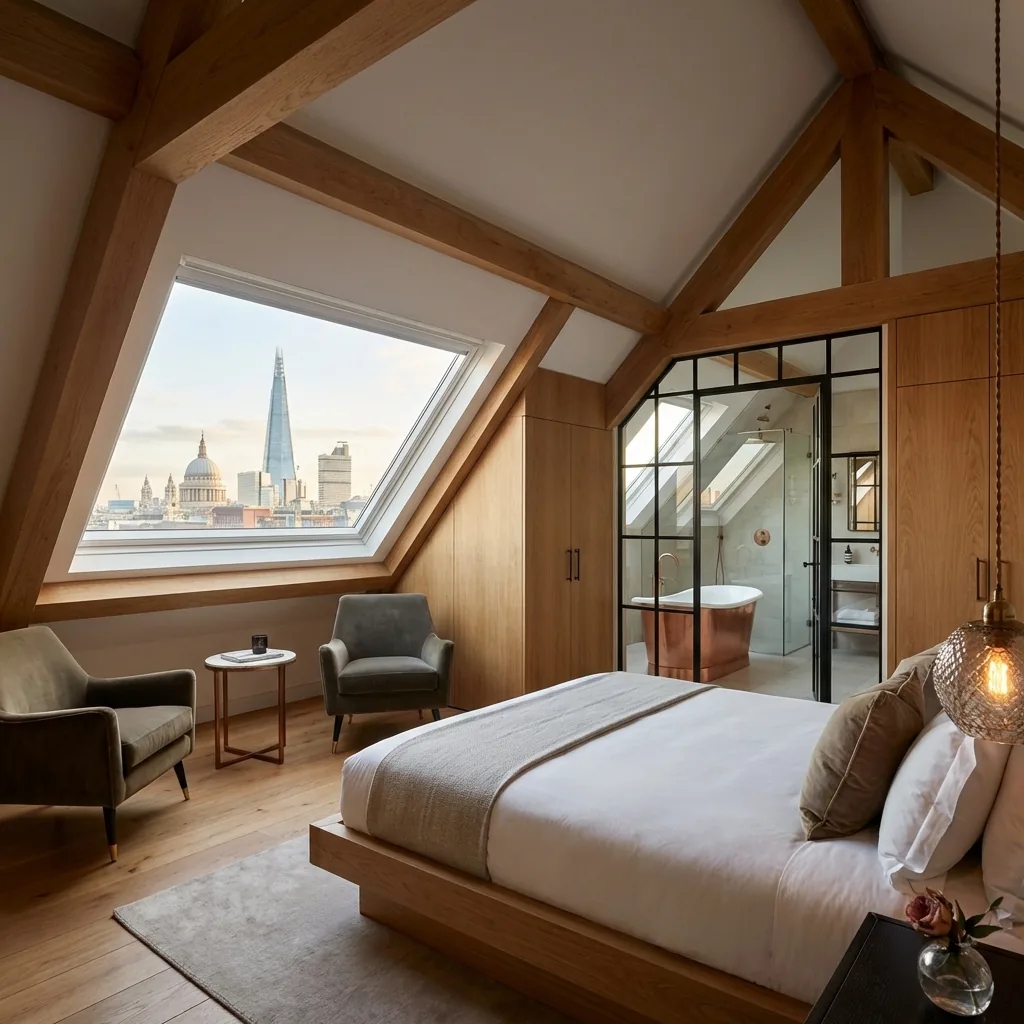
What Rooflights and Skylights Are
The terms "rooflight," "skylight," and "roof window" are often used interchangeably, but they have distinct meanings. A rooflight is typically a fixed (non-opening) unit glazed into a roof, positioned flush or nearly flush with the roof plane. A roof window or opening rooflight is hinged and can open for ventilation and light control. A skylight is a colloquial term that can refer to any roof-mounted light source, including fixed rooflights, roof windows, and even domes or barrel vaults.
In this guide, "rooflight" refers to the fixed unit and "roof window" to the opening type. For Permitted Development purposes, the Planning Portal distinguishes between them — roof windows and opening rooflights are treated differently to fixed units.
Rooflights can be installed in flat roofs (where they sit flush with or project slightly above the roof plane) or in pitched roofs (where they follow the roof slope). The structural arrangement differs: flat roof rooflights need a curb or frame that sits on the structural roof, while pitched roof units are typically built into the rafters and aligned with the roof slope.
Permitted Development Rules for Rooflights
For most of London, rooflights are permitted without planning permission if they comply with specific rules. Understanding these limits is essential because exceeding them requires a planning application.
Height limit: The key Permitted Development rule is that rooflights must not be installed higher than the highest part of the existing roof. For a detached house with a hipped or pitched roof, this means the rooflight cannot extend above the ridge line. For properties with a flat roof, the rooflight cannot project more than 150mm above the roof plane (or 200mm if the existing building has previously been extended with rooflights).
Projection limit: In flat roofs, rooflights cannot project more than 150mm (0.15m) above the roof surface. In pitched roofs, the rooflight must be set flush or nearly flush with the slope — no domed structures that project significantly above the plane.
Number and spacing: There is no strict limit on the number of rooflights in Permitted Development terms, but each individual unit must meet the height and projection rules. If you want to install many rooflights across a large roof, each one is assessed individually for compliance.
Opening rooflights (roof windows): Opening rooflights or roof windows are treated slightly differently. The same height and projection limits apply, but the opening mechanism must be on the interior side of the glass (not a rooftop hatch). In loft conversions, opening rooflights are often required for ventilation and emergency egress, and these can be Permitted Development as long as they comply with the height rules.
When Planning Permission Is Needed
If your rooflight exceeds the Permitted Development limits (higher than the roof ridge, or projecting more than 150mm in a flat roof), you will need to apply for planning permission. Additionally, even if the rooflight is within the height/projection limits, planning permission is required if:
- Your property is in a conservation area. Many London conservation areas require planning permission for any rooflight, regardless of size.
- An Article 4 Direction has been applied to your area. This removes Permitted Development rights for certain alterations, including rooflights.
- Your property is a listed building. Listed Building Consent is required for any rooflight installation.
- The rooflight is visible from a public street or right of way and would materially harm the character of the area.
If you are uncertain, submit a pre-application enquiry to your local planning authority. This is a simple question asking whether your proposed rooflight requires planning permission — the response is non-binding but informative.
Permitted Development Height Rule
In most of London, rooflights can be installed in Permitted Development (no planning permission needed) if they do not exceed the height of the existing roof ridge and do not project more than 150mm above a flat roof. In conservation areas, check with your council first.
Building Regulations — Thermal Performance, Ventilation and Structural Load
Rooflights are treated as windows under Building Regulations Part L (Conservation of Fuel and Power). The U-value requirement is 1.4 W/m²K or better. Modern rooflights with double or triple glazing and thermally broken frames typically meet this standard, but specify the glazing carefully and ask the manufacturer for a U-value certificate.
In loft conversions, ventilation is critical. Part F (Ventilation) requires that habitable rooms have background ventilation — typically trickle vents (small openings) or, more commonly, an opening rooflight. If your loft bedroom has a fixed rooflight only, you must provide additional opening windows or a mechanical ventilation system to satisfy Building Regulations. A roof window (opening rooflight) that opens at least 45 degrees can be counted as an opening window for ventilation purposes.
Structural loading: Rooflights add load to the roof structure. A typical double-glazed unit weighs 15–25 kg per square metre. In pitched roofs, the rafter spacing and section must be checked to ensure they can carry the additional load. In flat roofs, the structural decking and any beams below must be assessed. Building Control will require structural calculations if the rooflight is large (typically over 1.5m x 1.5m) or if the existing roof appears undersized. For most standard loft conversions, the roof structure is adequate, but never assume — get a structural engineer to check.
Fire Escape Requirements for Loft Bedrooms
Loft bedrooms (bedrooms created in a loft conversion) require a means of escape in case of fire. Building Regulations Part B requires that bedrooms have an opening window or roof window as a secondary means of escape. The rooflight or escape window must meet specific size criteria:
- Minimum opening area: 0.33m² (approximately 575mm x 575mm) of clear opening.
- Minimum dimension: No single dimension of the opening can be less than 450mm. This ensures a person can fit through.
- Height of sill above floor: The sill of the escape window must not be more than 1.1m above the floor level of the room.
A standard opening roof window (e.g., a VELUX or Fakro window sized approximately 780mm x 980mm) typically provides a clear opening of around 0.5m² and easily meets the escape requirements. However, smaller roof windows or fixed rooflights do not; for these, you will need to provide a separate opening window (e.g., a casement window in a gable wall) that meets the escape criteria.
This is a non-negotiable requirement. Building Control will not approve a loft bedroom without a compliant escape window. Many homeowners overlook this and are surprised when Building Control rejects their loft conversion design. Plan for an escape window from the outset.
Types of Rooflight and When to Use Each
Fixed Flat Rooflight
A flat rooflight is a sealed glazing unit set into a frame on a flat roof, typically projecting 100–150mm above the roof plane. It is the simplest option — no moving parts, minimal maintenance, and good thermal performance if specified with quality glazing. The drawback is no ventilation — a fixed rooflight cannot open. In a habitable room, you will need additional opening windows or mechanical ventilation. Fixed rooflights are ideal for kitchens, hallways, and non-habitable spaces where openness is desired but ventilation can come from elsewhere.
Pitched/Roof Window (Opening Rooflight)
A roof window (such as a VELUX or Fakro) is installed in a pitched roof, aligned with the roof slope, and opens via a side hinge or centre pivot mechanism. Roof windows are the standard choice for loft conversions because they provide ventilation, daylighting, and a means of escape. They are more complex structurally (requiring rafter cutting and flashing detail) but offer significantly more functionality. A typical loft bedroom rooflight would be a roof window sized 780mm x 980mm or larger.
Walk-On Glass / Frameless Glass Rooflight
Walk-on glass rooflights are structural glazing units designed to be tramped on and walked across — typically used on flat roofs or low-pitched roofs where maintenance access is needed. These are expensive, highly structural, and not commonly used in residential extensions. They are more relevant to commercial or industrial applications.
Dome or Barrel Vault Rooflight
Dome rooflights project significantly above the roof plane, creating a rounded or barrel-vault profile. They maximize light penetration and create a striking visual effect but exceed the Permitted Development height limit in most cases. Planning permission is usually required. Domes are thermally challenging (their curved shape makes them harder to insulate efficiently), and they are less common in London residential extensions than flat or pitched roof options.
Tubular Daylight Device (TDD)
A tubular daylight device is a thin tube (typically 300–500mm diameter) that captures light from the roof and channels it through a reflective duct to a diffuser in the ceiling below. TDDs are useful for bringing light to interior spaces (such as bathrooms or hallways) where a traditional rooflight cannot be positioned directly above. They are very thermally efficient and can be smaller than a rooflight opening. However, they are expensive and require careful installation to minimize light loss in long runs.
Conservation Area and Article 4 Restrictions
Many London conservation areas have supplementary planning guidance that restricts rooflights visible from public streets. The key principle is that traditional pitched roofs should not be significantly altered by large or prominent rooflights. In practice, this means:
- Rear-facing rooflights (not visible from the street) are generally acceptable, even in conservation areas.
- Front-facing or side-facing rooflights visible from a public right of way require careful assessment and may be refused if they appear out of character.
- In some conservation areas, conservation officers prefer traditional roof windows (VELUX-type units) over contemporary frameless glass or domes.
Article 4 Directions are sometimes applied to conservation areas to remove or restrict Permitted Development rights. If an Article 4 is in place for "alterations to the roof," any rooflight (even small ones) requires planning permission. Always check your local planning authority's website or conservation area guidance before proceeding with a rooflight design.
Specification — Glazing Performance and Thermal Efficiency
U-value: Modern rooflights should achieve a U-value of 1.4 W/m²K or better. Double-glazed units with low-emissivity (low-E) coatings typically meet this; triple glazing achieves even better performance (around 0.8–1.0 W/m²K). For extensions, double glazing with a low-E coating is standard; triple glazing is used in high-performance or Passive House projects.
Solar heat gain coefficient (SHGC): Rooflights, especially roof windows, receive direct sunlight and can cause overheating, particularly in south-facing rooms. Specify glazing with a lower SHGC (around 0.3–0.4) to reduce solar gains. Many manufacturers offer tinted or coated options that reduce heat gain without compromising light transmission. Alternatively, provide external shading (a roof overhang or louvre system) to control solar gain.
Self-cleaning glass: Some rooflights are available with self-cleaning coatings that reduce the frequency of manual cleaning. For roof windows that are difficult to access, this is a practical option. The coating is a hydrophilic layer that breaks down organic matter and allows water to sheet off, reducing grime accumulation.
Manual vs. electric opening: Roof windows can be opened manually (via a handle) or electrically (via a motor controlled by a switch or remote). Manual opening is fine for small rooms or easily accessible windows; electric opening is a convenience for high or hard-to-reach windows. Electric systems can be integrated with sensors (rain sensors, temperature sensors) to automate opening and closing.
Installation and Structural Considerations
In pitched roofs, installing a roof window requires cutting rafters and fitting a structural header (beam) to carry the loads above. A structural engineer must assess whether the existing rafters are adequate or whether they need strengthening. The flashing detail is critical — poor flashing leads to water ingress around the rooflight frame. Modern flashing systems are well-designed, but installation quality is paramount. Hire experienced roofers familiar with the specific rooflight system being used.
In flat roofs, a rooflight is mounted on a structural curb that transfers loads to the structural deck below. The curb must be securely fastened and the junction between the curb and rooflight must be sealed with high-quality sealants or gaskets to prevent water entry.
Insulation around the rooflight is important. The frame of the rooflight should not create a thermal bridge — where the metal or plastic frame conducts cold from outside to inside. Specify rooflights with thermally broken frames. Additionally, ensure insulation is continuous around the rooflight opening to prevent condensation and thermal loss.
Rooflights are popular in loft conversions because they meet fire escape requirements, provide natural light, and enhance the sense of space. However, they are one of the most common points of water ingress if installed poorly. Specification and installation quality matter enormously.
Common Planning Pitfalls with Rooflights
Installing a rooflight higher than the roof ridge: This is the most common reason for refusal or enforcement action. Even a small overhang above the ridge can trigger a planning breach. Measure carefully and verify the exact position of the roof ridge before finalizing the rooflight location.
Forgetting conservation area restrictions: Do not assume a small rooflight is acceptable in a conservation area just because it is within Permitted Development limits in other areas. Many London conservation areas require planning permission. Check early.
Multiple rooflights creating a visually dominating pattern: A single rooflight may be acceptable, but three or four rooflights across a roof can create a visually cluttered appearance that planning officers may refuse on character grounds. Consider the visual balance of your roof design.
Failing to provide an escape window in a loft bedroom: Loft bedrooms require a compliant escape window meeting fire safety standards. If your rooflight is too small or too high to serve this purpose, plan for a separate escape window from the outset.
| Type | Planning (PD ok or not) | Opening/Ventilation | Fire Egress | Loft Use | Conservation Area Suitability | Maintenance |
|---|---|---|---|---|---|---|
| Fixed Flat Rooflight | Usually PD if within 150mm projection limit | No opening; requires separate ventilation | Cannot serve as escape window; separate window needed | Not suitable for bedrooms without additional escape window | Good if rear-facing and not prominent | Minimal; sealed unit |
| Pitched/Roof Window | Usually PD if within roof ridge height limit | Opens for ventilation; 45° opening acceptable | Can serve as primary escape window if >0.33m² opening | Ideal for loft bedrooms; standard choice | Good if sympathetically designed; traditional style preferred | Moderate; hinges and seals need occasional servicing |
| Walk-On Glass | Usually requires planning permission | No opening (structural glazing) | Cannot serve as escape window | Not suitable for residential bedrooms | Less common; may be refused as visually prominent | Regular cleaning essential; expensive if damaged |
| Dome/Barrel Vault | Typically requires planning permission (exceeds height limit) | Fixed or rarely opening; minimal ventilation | Usually cannot serve as escape window | Suitable for living areas; less ideal for bedrooms | Often refused in conservation areas; contemporary style may not fit | Moderate; curved glass harder to clean |
| Tubular Daylight Device | Usually PD if roof opening within limits | No opening; passive light transfer only | Cannot serve as escape window | Good for bathrooms/hallways; not for primary bedrooms | Excellent; minimal visible alteration to roof | Minimal exterior maintenance; interior diffuser cleaning |
Frequently Asked Questions
Do I need planning permission for a rooflight in a loft conversion?
Not usually, if the rooflight is within Permitted Development limits (does not exceed the roof ridge height, and does not project more than 150mm in a flat roof). However, conservation areas and Article 4 Directions may require planning permission. Check with your local planning authority if you are unsure.
Can a fixed rooflight be used as the escape window for a loft bedroom?
No. A fixed rooflight cannot be used as an escape window because it does not open. Loft bedrooms require an opening window (roof window, casement window, or sliding window) that can open at least 45 degrees and provide a clear opening of 0.33m² with no dimension less than 450mm.
What U-value must a rooflight in an extension achieve?
Building Regulations Part L requires a U-value of 1.4 W/m²K or better. Modern double-glazed rooflights with low-emissivity coatings and thermally broken frames typically meet this standard. Ask the manufacturer for a U-value certificate.
Does a rooflight provide adequate ventilation for a habitable room?
A roof window (opening rooflight) that opens at least 45 degrees can count as an opening window for ventilation purposes. However, a fixed rooflight does not provide adequate background ventilation; you will need to install additional opening windows or a mechanical ventilation system to comply with Building Regulations.
How much structural strengthening is needed for a roof window in an existing pitched roof?
This depends on the existing rafter size and spacing. For a typical loft conversion with standard rafter sizes (e.g., 100mm x 200mm at 400–600mm spacing), a single standard-sized roof window (e.g., 780mm x 980mm) usually requires only minor local reinforcement around the opening. A structural engineer must assess this; do not assume no reinforcement is needed.
Can I install a rooflight if my property is in a conservation area?
Possibly, but conservation area status often requires planning permission, even for Permitted Development-sized rooflights. Rear-facing rooflights are more likely to be approved than front-facing ones. Check your local conservation area guidance and submit a pre-application enquiry to the planning authority.
What is the difference between a rooflight and a roof window?
A rooflight is typically a fixed (non-opening) unit, while a roof window is hinged or pivoting and can open for ventilation. In planning and building control terms, they are treated similarly, but a roof window is essential for loft bedrooms (fire escape) and habitable rooms (ventilation).
Can I install an electric roof window instead of a manual one?
Yes. Electric roof windows are widely available and offer convenience, especially for windows that are high or difficult to reach manually. They can be automated with rain sensors or temperature sensors. Building Regulations do not distinguish between manual and electric opening; both satisfy the requirement equally.
What is self-cleaning glass on a rooflight?
Self-cleaning glass has a hydrophilic coating that breaks down organic matter and allows water to sheet off, reducing grime and dirt accumulation. For roof windows that are difficult to access for manual cleaning, self-cleaning glass is a practical option. It does not eliminate the need for occasional manual cleaning but reduces frequency.
Does a rooflight need building control approval?
Yes. All rooflight installations must comply with Building Regulations (thermal performance, structural adequacy, ventilation, fire safety). You should notify Building Control and obtain approval before installation. They will inspect the work and sign it off on completion.
How do I prevent condensation on a rooflight?
Condensation occurs when warm, moist air inside meets cold glass. To prevent it: (1) specify rooflights with thermally broken frames and low U-values, reducing the cold surface temperature; (2) ensure adequate ventilation (opening windows or mechanical ventilation) to reduce interior humidity; (3) avoid installing rooflights in rooms with high moisture (bathrooms, kitchens) without additional extraction ventilation.