
Permitted Development Rights for London Houses — What You Can Build Without Planning Permission
By My Local London Builder Team | March 2026 | 10 min read
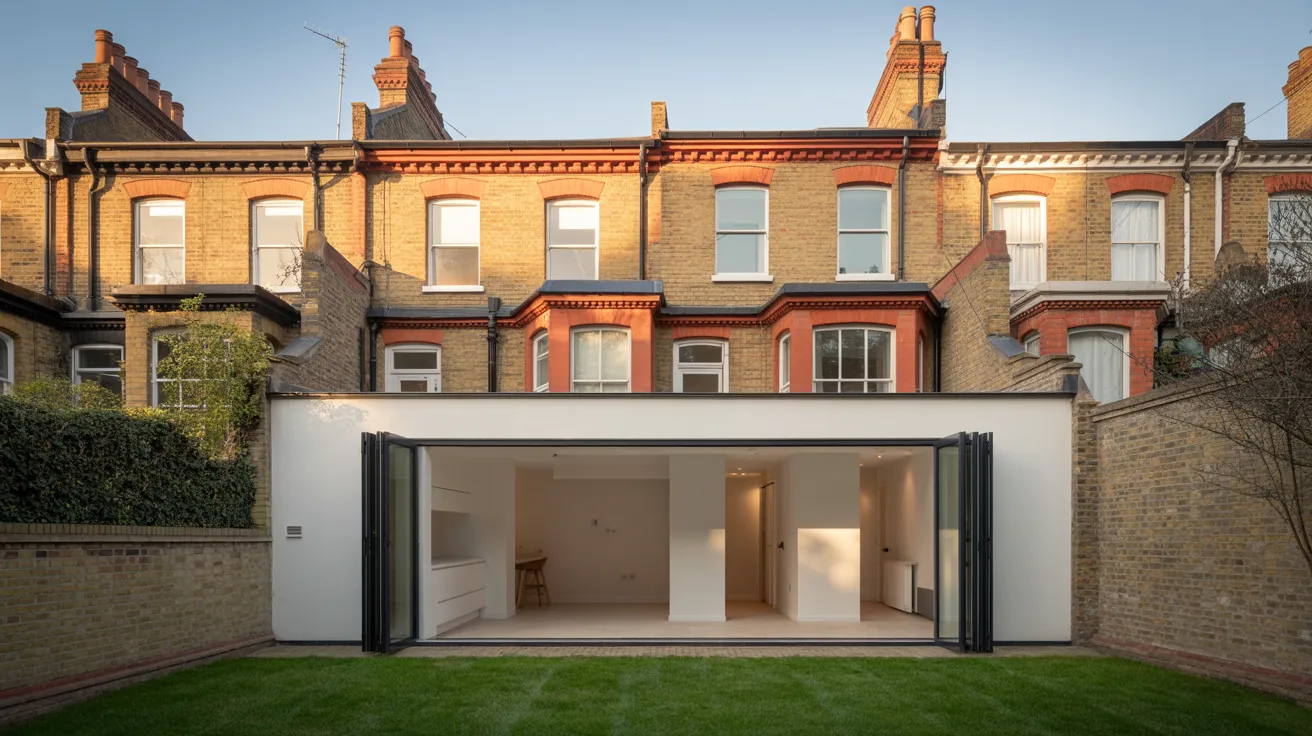
Summary: Permitted Development (PD) rights allow London homeowners to carry out certain works—extensions, loft conversions, rooflights, and outbuildings—without a full planning application. However, these rights come with strict conditions and geographic limitations. Understanding what you can and cannot build, how Article 4 Directions affect your property, and when to obtain a Lawful Development Certificate is essential before starting any work.
What Permitted Development Rights Are
Permitted Development rights represent a national grant of planning permission, enshrined in Parliament's Town and Country Planning (General Permitted Development) Order 2015. They exist as a streamlined alternative to the full planning application process for certain defined categories of residential work. Rather than requiring you to submit detailed plans, pay application fees, and wait for a planning officer's decision, PD rights allow specific works to proceed automatically, provided they meet strict dimensional, materials, and location criteria.
These rights apply exclusively to dwelling houses—not flats or apartments. A "house" for PD purposes means a building designed as a single dwelling unit and occupied as such. This distinction is important: if you own a flat, even if you own the freehold, PD rights for householders do not apply. The legislation assumes that in a terraced, semi-detached, or detached house, the householder (not a local authority) is the best judge of what minor works are appropriate.
Different classes of work fall under different designations. Class A covers single-storey extensions to the rear and side of a house. Class B covers loft conversions, including the addition of roof space and dormer windows. Class C covers rooflights installed on existing roofs. Class E covers outbuildings and other garden structures. Each class has its own detailed specifications about dimensions, materials, and location. Understanding which class your proposed work falls under is the first step to determining whether you need planning permission.
The purpose of PD rights is partly practical and partly philosophical. Practically, they reduce the administrative burden on local authorities, freeing planning officers to focus on larger, more complex schemes. Philosophically, they reflect a presumption in favour of modest domestic improvement. However, this presumption is not absolute. Local authorities can withdraw PD rights through an "Article 4 Direction," and certain properties—listed buildings, those in conservation areas, those subject to planning conditions—have restricted or no PD rights at all.
Class A — Extensions and Additions
Single-storey rear extensions represent the most common use of PD rights in London. Under standard PD, a terrace or semi-detached house can extend up to 3 metres deep from the existing rear elevation, while a detached house can extend up to 4 metres. These dimensions are measured horizontally from the original building line and apply only to single-storey structures. A two-storey extension, by contrast, almost always requires full planning permission, regardless of depth.
In 2016, the government introduced the Larger Home Extension Prior Approval Scheme (sometimes called the Larger Home Extension Scheme), which allows single-storey rear extensions to extend further: up to 6 metres for terraced and semi-detached houses, or 8 metres for detached houses. However, this extended permission is not automatic. It requires Prior Approval from the local planning authority, which means the council must be notified, adjoining neighbours consulted, and objections considered within a 42-day period. If neighbours object on grounds of impact on their amenity, the council can refuse. This is an important distinction: the Larger Home Extension Scheme provides more generosity on depth but at the cost of a formal (though quicker) approval process.
All extensions—whether under standard PD or the Prior Approval Scheme—are subject to additional constraints. The total area of the extension, combined with any previous extensions, must not exceed 50% of the total area of the curtilage (roughly, the garden and grounds) of the original house. This means you cannot simply convert your entire garden into a built structure. The extension must not extend forward of the principal elevation (the front of the house). The eaves height and ridge height of the extension must not exceed those of the original house. These height restrictions exist to maintain visual consistency within streets and neighbourhoods.
The external materials used in the extension must be of similar appearance to the existing house. This rule prevents jarring visual contrasts—for example, a rendered extension on a brick house, or vice versa. The colours, textures, and finishes should complement the original building. No veranda, balcony, or raised platform is permitted between the extension and the garden. This restriction keeps extensions integrated with the existing house and garden plane.
Side extensions fall into a narrower category. A single-storey side extension is PD if it does not exceed half the width of the original house. It must not result in two storeys on the side of the building. In practice, this means a single-storey side extension is allowed, but only if it is narrower than half the house width. Many London terraces with narrow side returns (3–4 metres wide) will fail this test. In addition, if your property is subject to an Article 4 Direction, side extensions typically lose their PD status entirely, and full planning permission becomes necessary.
Class B — Loft Conversions
Loft conversions are among the most popular uses of PD rights in London, particularly in Victorian and Edwardian terraces where the roof space is often substantial. PD rights allow you to add a loft conversion without a planning application, but with strict volumetric limits. For a terraced house, you can add up to 40 cubic metres of additional roof space. For a semi-detached or detached house, the allowance is 50 cubic metres. These limits are cumulative over the lifetime of the building: if a previous owner already converted part of the loft, that volume counts against your allowance, even if it occurred decades ago. You should request evidence from the previous owner or a surveyor to determine how much "allowance" remains.
The roof space created by a loft conversion must not exceed the highest point of the existing roof. This prevents homeowners from raising the roof line to create dramatically taller volumes. The conversion must not extend beyond the plane of the existing roof slope on the principal (front) elevation. In practice, this means you cannot add a dormer window on the front face of the house, though rear dormers and side dormers may be permissible, subject to other conditions.
Dormer windows themselves are subject to strict rules. A dormer must be set in from the eaves by at least 20 centimetres. This spacing requirement prevents dormers from appearing to "leap" directly from the gutter, which would be visually awkward. The dormer must be single-storey (not a two-storey structure protruding from the roof). The materials used must be of similar appearance to the existing dwelling, maintaining visual coherence.
No veranda, balcony, or raised platform is permitted on a loft conversion. The conversion is purely an internal volume gain; no external structures can be added. This rule keeps conversions visually minimal and prevents them from altering the external massing of the house.
One practical consideration: if your loft conversion includes a structural engineer's design, the engineer must ensure that the structural changes comply with Building Regulations and do not exceed the PD limits. A surveyor can help you understand whether a proposed design falls within PD or requires planning permission. In inner London, many loft conversions are carried out under PD, but the interaction with Article 4 Directions (discussed below) means that in some boroughs, a loft conversion may require full planning permission even if it would otherwise be PD.
Class C — Rooflights
Rooflights are among the simplest uses of PD rights. You can add rooflights to any roof on your house without planning permission, provided they project no more than 150 millimetres beyond the surface of the roof slope. This small projection allowance lets light in without creating visually obtrusive structures. Rooflights are commonly added to loft conversions and to existing upper-floor rooms during renovation.
However, if your property is in a conservation area, the rules tighten. Front-facing rooflights on conservation areas are often restricted. Some conservation area guidance prohibits rooflights on the front principal elevation entirely, while others allow them if they are small and flush-fitting. You should check your local conservation area character appraisal or contact your borough's planning team to confirm whether front rooflights are PD in your specific conservation area.
Class E — Outbuildings and Garden Structures
You can build a single-storey outbuilding—a garden office, workshop, or storage structure—under Class E PD rights, provided several conditions are met. The structure must be within the curtilage (the grounds and garden) of the house. It must not be positioned forward of the principal elevation; in other words, it cannot sit in your front garden in a way that is nearer to the street than the front of the house. The eaves height must not exceed 2.5 metres if the structure is within 2 metres of a boundary. If it is more than 2 metres away from the boundary, the eaves height can reach 3 metres, but the overall height (measured to the ridge or highest point) cannot exceed 4 metres for a dual-pitch roof or 3 metres for other roof types.
The total coverage of all outbuildings on the property must not exceed 50% of the curtilage area of the original house. This means if your house originally had a garden of 100 square metres, outbuildings cannot exceed 50 square metres in total footprint. This rule prevents a backyard from being entirely built over.
Critically, an outbuilding cannot be used as a separate dwelling or holiday let. It must be ancillary to the main house. If you build a garden office that is later used as a holiday let, you may be in breach of planning control, and the council can serve an enforcement notice. The same applies if you convert an outbuilding into a self-contained flat or bedsit.
| Class | What It Covers | Key Limits | Applicable To |
|---|---|---|---|
| Class A | Extensions — single and two-storey | 3m rear depth (terrace/semi); 4m (detached); no wider than half house; no higher than eaves | Houses (not flats); not listed buildings |
| Class B | Loft conversions and dormers | 40m³ cumulative (terrace); 50m³ (semi/detached); no front dormers on highway elevation; max = existing ridge height | Houses (not flats); not listed buildings |
| Class C | Rooflights on existing roofs | Must not project more than 150mm beyond the roof slope | Houses; restricted on front slopes in conservation areas |
| Class E | Outbuildings and garden structures | Single-storey; max 2.5m eaves if within 2m of boundary; no more than 50% of original curtilage; not forward of principal elevation | Houses (not flats); cannot be used as a separate dwelling |
| Route | When It Applies | Process | Typical Timeline | Neighbour Input? |
|---|---|---|---|---|
| Permitted Development | Works within PD limits; no Article 4 or conservation area removal | No application required. An LDC is optional but strongly recommended | Immediate (8 weeks if obtaining an LDC) | No |
| Prior Approval (LAHE) | Single-storey rear extensions between standard PD depth and 6m (terrace/semi) or 8m (detached) | Application submitted to LPA; adjoining owners notified; LPA assesses neighbour objections on amenity grounds | 42 days from validation | Yes — 21-day consultation window |
| Full Planning Permission | Works outside PD limits; conservation areas; Article 4 areas; listed buildings; two-storey side extensions | Full application with drawings; public consultation; planning officer assessment against local and national policy | 8–13 weeks (varies by borough) | Yes — full public consultation |
When Permitted Development Rights Do Not Apply
Understanding the exceptions to PD is as important as understanding PD itself, because many London properties fall into exception categories where PD rights are reduced or non-existent.
Listed buildings: Buildings listed on the National Heritage List have no PD rights whatsoever. Any structural or external work to a listed building requires Listed Building Consent from the local planning authority, in addition to (or instead of) planning permission. Listed Building Consent is a separate and more stringent approval process, often involving detailed heritage justifications.
Conservation areas: Properties in conservation areas retain some PD rights, but they are narrower. For loft conversions (Class B), rooflights on the front elevation are typically not permitted. Dormer windows on the front of the house are usually not allowed. Extensions may also be more restricted; some conservation areas have Local Authority policies that further limit or remove PD rights for certain works. You must check your specific conservation area guidance or contact your borough planning team.
Article 4 Directions: A local planning authority can make an Article 4 Direction, which formally removes specified PD rights within a defined area. Once in force, an Article 4 Direction converts what would otherwise be PD into a requirement for a formal planning application. Article 4 Directions are particularly common in inner London, affecting large swathes of Victorian and Edwardian neighbourhoods. If your property is subject to an Article 4 Direction, virtually all residential extensions, loft conversions, and outbuildings will require planning permission.
Flats: PD rights for householders apply only to houses, not flats. The legislation explicitly excludes purpose-built flats and conversions into multiple units. If you own a flat, any alterations to the exterior—windows, doors, rooflights, additions—require planning permission.
Planning conditions: If your house was granted planning permission subject to a condition removing PD rights, that condition overrides the default PD allowance. Check your original planning permission letter to see if any such condition exists. If in doubt, ask the planning department.
What Is an Article 4 Direction?
An Article 4 Direction is a formal legal instrument made by the local planning authority that withdraws specified PD rights within a defined area or affecting specific types of properties. The direction is based on Article 4 of the Town and Country Planning (General Permitted Development) Order 2015, hence the name.
Article 4 Directions are made when a local authority believes that the exercise of PD rights would be contrary to the public interest, often because an area is of particular character or heritage value, or because the cumulative impact of incremental changes has been harmful. In London, Article 4 Directions are extremely common in inner boroughs.
Several boroughs have particularly extensive Article 4 coverage. Islington has an Article 4 Direction covering much of the borough, removing PD rights for extensions and loft conversions across large residential areas. Hackney, Lambeth, Southwark, Camden, and Tower Hamlets also have significant Article 4 coverage. If you live in any inner London borough, it is highly likely that your property is affected.
To check whether your property is subject to an Article 4 Direction, search your local borough's planning portal (usually available on the council website) or visit the Planning Portal's national map at planningportal.co.uk. Many councils maintain a definitive register of Article 4 Directions affecting their area. If you are uncertain, contact the planning duty officer at your local council.
If an Article 4 Direction applies to your property, a rear extension that would otherwise be PD becomes a requirement for full planning permission. This means you must submit plans, pay an application fee, and await the planning officer's decision, which typically takes 8–13 weeks. The upside is that if the council approves your application, the permission is formal and not subject to challenge (after a certain period). The downside is time and cost.
The Larger Home Extension Prior Approval Scheme
In 2016, the government introduced the Larger Home Extension Prior Approval Scheme as a middle ground between full planning permission and standard PD. Under this scheme, single-storey rear extensions can extend up to 6 metres deep on a terraced or semi-detached house, or 8 metres on a detached house—double the standard PD limits of 3 metres and 4 metres respectively.
However, the extension does not automatically proceed. Instead, the homeowner must notify the local planning authority and the scheme requires Prior Approval. The council must consult with adjoining owners and occupiers, who have 21 days to submit observations (not formal objections, but comments and concerns). The authority then has 42 days from validation to determine whether to approve, impose conditions, or refuse.
The grounds for refusal are specific: the council can refuse if it considers that the proposal would have an unacceptable impact on the amenity of adjoining neighbours in terms of light, privacy, or outlook. The assessment is less broad than a full planning application; the council cannot refuse on grounds of design quality or character in isolation, only on amenity impact.
If the council does not respond within the 42-day period, the Prior Approval is deemed granted automatically. This "deeming" provision incentivises councils to issue decisions promptly. Many councils use this deadline strategically; if they receive a Prior Approval application, they review it quickly and issue a decision before the 42 days expire.
The Prior Approval Scheme still requires all other PD conditions to be met: the extension must not exceed 50% of the original curtilage, must not exceed the height of the original house, must use similar materials, and so forth. It is not a shortcut to permission for an extension that would otherwise be non-compliant with PD criteria. It is solely an extension to the depth allowance.
Should You Get a Lawful Development Certificate?
A Lawful Development Certificate (LDC) is a formal written confirmation from the local planning authority that a proposed or existing work is lawful under planning law—either because it is PD, or because planning permission was granted, or because the work has been carried out for long enough that enforcement is no longer possible.
Obtaining an LDC is not legally required to undertake PD works. If you are confident that your extension meets all PD criteria, and your property is not subject to any restrictions, you can proceed without an LDC. However, there are several reasons to consider obtaining one.
First, when you sell your property, a buyer's solicitor and surveyor will ask for evidence that any extension or loft conversion is lawful. Without documentation, doubt arises. The buyer may demand indemnity insurance (a policy protecting against future enforcement action), which can be expensive and may be refused if the council has recently been active in enforcement in your area. An LDC eliminates this uncertainty and makes the property more attractive and easier to sell.
Second, from April 2024, the enforcement period for buildings without planning permission or LDC changed. Previously, if a building work had been in place for four years without enforcement action, it became "immune" and could not be enforced against. This four-year rule has been extended to ten years. This change makes obtaining an LDC even more important for recent works. More broadly, Labour's 2024 planning reforms are reshaping how extensions are assessed across London. If you carried out an extension in 2020, for example, the ten-year rule means the council can still take enforcement action until 2030. An LDC removes this risk entirely.
To obtain an LDC, apply via the Planning Portal or directly to your local planning authority. You will need to submit plans and a written statement explaining why the work is lawful (e.g., "This extension complies with Class A PD rights because it is single-storey, 3.5 metres deep, and in a detached house, etc."). The council will review the application, and if satisfied, will issue an LDC. There is a fee, typically between £150 and £250, depending on your authority.
For existing works, the LDC process includes a formal "certificate of lawfulness" determination. For proposed works, it is a "certificate of intended use," confirming that the work, once completed as proposed, will be lawful. Either way, the certificate provides legal certainty and protection against future enforcement.
Common Mistakes London Homeowners Make With PD Rights
Understanding PD rights is one thing; applying them correctly is another. Several common pitfalls trip up London homeowners.
Assuming inner London properties have PD rights: This is the most frequent mistake. Many homeowners in inner London assume they can extend under PD, only to discover that an Article 4 Direction has removed those rights. Always check before proceeding. A five-minute call to the planning department can save months of delay and hundreds of pounds in wasted design costs.
Exceeding cubic metre limits on loft conversions: Because the 40/50 cubic metre limits are cumulative, many homeowners are unaware of how much "allowance" remains. If a previous owner added a loft conversion 20 years ago, that volume counts against the current allowance. Exceeding the limit by even a small amount means the work is not PD and requires planning permission. Have a surveyor measure any existing loft space before designing your conversion.
Using inconsistent facing materials: Using brick on a rendered house, or cladding on a brick terraced house, looks jarring and violates the PD requirement for "similar appearance." Homeowners often make this mistake when trying to economize on materials. The extra cost of matching materials is insignificant compared to the cost of enforcement action requiring the work to be remedied.
Building side extensions that are too wide: The rule limiting side extensions to half the width of the original house is often exceeded. On a 6-metre-wide terraced house, a side extension can be no wider than 3 metres. Exceeding this results in a loss of PD status. A surveyor should verify dimensions before work starts.
Assuming "rear" always means PD: A common belief is that if an extension is at the back of the house, it is automatically PD. This is false. A two-storey rear extension requires full planning permission, regardless of depth or location. Only single-storey rear extensions are PD, and only if all other conditions are met.
Not obtaining an LDC before selling: Many homeowners complete an extension, assume it is PD, and sell without documentation. Buyers' solicitors increasingly request an LDC or indemnity insurance. Without one, the sale may stall or require price renegotiation. Obtaining an LDC proactively can be the difference between a smooth sale and a difficult one.
Frequently Asked Questions
Do I need planning permission if my extension is at the rear?
Not necessarily, but PD rights are subject to conditions. A single-storey rear extension up to 3m deep on a terrace may be PD, but only if all other conditions are met and PD rights haven't been removed by an Article 4 Direction or conservation area restrictions. A two-storey rear extension almost always requires full planning permission.
How do I check if my property has an Article 4 Direction?
Via your local borough's planning portal or by searching the Planning Portal's national map. You can also call the planning duty officer at your local borough.
What is the Larger Home Extension Prior Approval Scheme?
It allows single-storey rear extensions of up to 6m (terrace/semi) or 8m (detached) without full planning permission, subject to a neighbour consultation process and a 42-day determination period.
Can I extend my house if it is in a conservation area?
Possibly, but the range of PD rights available is narrower. Loft conversions with rear dormers may still be possible, but front-facing dormers are prohibited. Side and rear extensions may require full planning permission, depending on local conservation area guidance.
Does Permitted Development apply to flats?
No. PD rights for householders apply only to dwelling houses, not flats. Any works to a flat require planning permission.
How much of my roof can I convert under Permitted Development?
40 cubic metres for a terrace, 50 for semi or detached. This is a cumulative figure: if a previous owner already converted part of the loft, that volume counts against your allowance.
What is a Lawful Development Certificate and why would I need one?
A formal written confirmation from the local planning authority that your works are lawful. Not required to build, but strongly recommended — particularly when selling, since conveyancers will ask for evidence. From April 2024, the enforcement window extended to ten years, making an LDC even more valuable.
Can I build an outbuilding in my garden without planning permission?
Usually yes, under Class E, provided it is single-storey, not forward of the principal elevation, within the eaves and ridge limits, and does not cover more than 50% of the original curtilage.
Are there any PD rights for side extensions?
Yes, but they are limited: a single-storey side extension can be built under PD if it is no wider than half the original house and does not result in a two-storey side addition. In many inner London boroughs, Article 4 Directions also remove this right.
What happens if I exceed PD limits?
If works exceed PD limits without a planning application, they are technically in breach of planning control. The council can issue an enforcement notice requiring the works to be amended or removed.