
Extending a Semi-Detached House in London — What's Possible and What to Expect
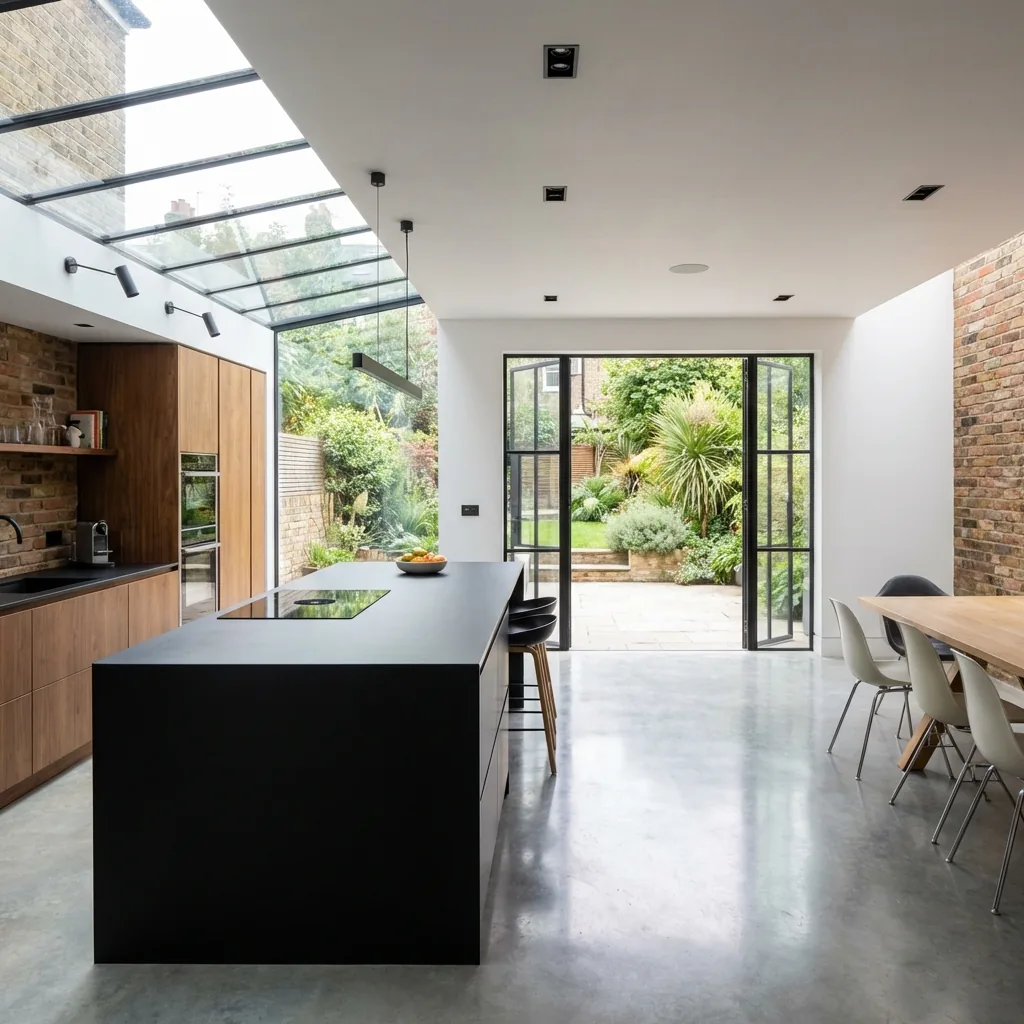
Semi-detached houses are among the most versatile properties to extend in London. With one party wall instead of two, a wider plot, and often a hipped roof, they offer design opportunities that terraced properties simply cannot match. This guide covers rear extensions, side extensions, the planning rules that differ from terraced properties, structural considerations, and the design approaches that work best on inter-war and Victorian semis.
How Semi-Detached Properties Differ From Terraced Houses
The semi-detached house occupies a particular sweet spot in the London property market. Unlike a mid-terrace property, which is constrained on both sides by party walls, a semi-detached house has only one shared wall — the boundary with the adjoining property. The other side is entirely exposed: either a gable end or a blank elevation against the property boundary. This single fact fundamentally changes what is possible for extension and improvement.
Plots are typically larger than their terraced equivalents. The rear garden is often wider, and the side elevation — unconstrained by a neighbour — opens up design possibilities that mid-terrace owners can only dream of. A side extension is not merely an afterthought or a compromise; it is a genuine architectural opportunity that shapes how the house can grow.
The roof form matters too. Inter-war semis, which are everywhere in outer London, typically feature hipped roofs — roofs that slope down on all four sides. This is particularly significant because it creates an opportunity for a hip-to-gable loft conversion, a conversion type that is not available on traditional terraced houses. The hipped geometry, combined with the generous floor area of a typical 1930s semi, makes these properties ideal candidates for loft extension.
The planning rules are partly different from terraced properties, and in some cases, they work more favourably for semi owners. The standard Permitted Development (PD) allowance for a single-storey rear extension is 4m for a semi-detached house, compared to just 3m for a terraced property — an additional metre that can make a real difference in kitchen design. Under the government's Larger Home Extension Prior Approval Scheme, semis are allowed to extend up to 6m, the same as terraced properties. However, on a wider semi plot, the additional depth matters less than it would on a narrow terrace garden.
Party wall procedures also differ. A semi-detached house requires only one party wall notice (for works affecting the shared wall with the neighbour), whereas a mid-terrace property requires two — one on each side. Works on the non-shared side of a semi can be undertaken without formal party wall procedures, provided the boundary position is confirmed and the builder respects the neighbour's boundary.
The exposed side elevation creates another layer of design freedom. A mid-terrace property has only one unshared elevation: the front. A semi-detached house has two: front and side. This means that a well-designed semi can be extended in ways that maintain architectural coherence from every angle, not just from the front as on a terrace.
| Extension Type | PD Eligible? | Typical Planning Route | What You Gain | Key Constraint |
|---|---|---|---|---|
| Single-storey rear (up to 4m) | Yes — if PD rights intact | PD (LDC recommended) | Larger kitchen-diner; garden connection | Article 4 removes right in many inner-London boroughs |
| Single-storey rear (4–6m) | Yes — Prior Approval | Larger Home Extension Prior Approval (42 days) | Full-depth kitchen-dining extension; island and full-width glazing | Neighbour consultation; LPA can refuse on amenity grounds |
| Two-storey rear | Rarely — 7m boundary rule usually not achievable | Full planning permission | Kitchen-diner below + bedroom/bathroom above | Neighbour daylight and outlook; overlooking; conservation area restrictions |
| Single-storey side extension | Yes — if no wider than half house width | PD or full permission (Article 4 common) | Wider ground floor; utility room; garage replacement | Half-width rule; Article 4 in many boroughs; semi-pair symmetry |
| Two-storey side extension | No | Full planning permission | Additional bedroom above ground-floor side addition | Shark fin risk; semi-pair symmetry; overlooking; streetscene impact |
| Wraparound (rear + side combined) | Rarely | Full planning permission | Large open-plan ground floor; maximum footprint gain | Side component almost always removes PD eligibility |
| Hip-to-gable loft conversion | Yes — within 50m³ cumulative allowance | PD (LDC recommended) | Full loft floor — typically bedroom + en suite | Conservation areas; Article 4; cumulative volume limit |
| Hip-to-gable + rear dormer | Yes — combined within 50m³ | PD (LDC recommended) | Maximum loft floor area; bedroom, en suite, landing | Party Wall Act for loft floor at party wall; volume limit |
Rear Extensions on a Semi-Detached House
Rear extensions on a semi follow broadly the same rules as on a terraced property, but the proportions change. A single-storey rear extension up to 4m deep is Permitted Development under standard PD rules, provided no Article 4 Direction or conservation area restrictions apply. This is 1m deeper than the 3m allowance for a terraced house — not a huge amount, but sufficient to accommodate an island unit in a kitchen that might otherwise feel tight. Under the Larger Home Extension Prior Approval Scheme, extensions up to 6m can be approved subject to neighbour consultation and prior approval from the local authority.
Two-storey rear extensions require full planning permission, just as they do on terraced properties. The standard advice is that an extension must be at least 7m from the rear boundary to qualify for PD, but in practice, most semi gardens are generous enough to accommodate a two-storey extension without hitting that constraint — the issue is often one of design rather than measurement.
Where a semi rear extension differs from a terrace is in width. A typical 1930s semi has a footprint of 4–5m across the rear elevation. A rear extension that spans the full width of the house is therefore genuinely possible — not a squeeze. And if the extension also wraps around to incorporate the side return or blank side elevation, the footprint becomes even more generous. This wraparound potential is explored in detail below.
The design of a semi rear extension should respond to the original house. On a hipped-roof property, the junction between the existing house and the new extension requires careful handling. If the hipped end is particularly steep and the extension rises to a significant height at that junction, the proportions can feel awkward. Many architects prefer to design the rear extension with a lower eaves line relative to the existing house, or with a mono-pitched roof that clearly reads as subordinate. A flat roof can work well, particularly if combined with minimal parapet detail and clean gutter runs.
Side Extensions — The Opportunity Unique to Semis
This is where semi-detached properties diverge most sharply from mid-terrace properties. A side extension is not possible on a mid-terrace house — there is no side to extend into. On a semi, the exposed side elevation can accommodate a single-storey or two-storey side extension, fundamentally changing the footprint and usable space of the house.
A single-storey side extension is Permitted Development under standard PD rules, provided it is no wider than half the width of the original house and does not result in a two-storey or multi-storey extension alongside the highway. However, many inner-London boroughs have removed these PD rights via Article 4 Directions, particularly in conservation areas and areas of architectural or townscape sensitivity. Always check with your local planning authority before assuming PD rights are available.
The "shark fin" problem is a well-known pitfall on semi-detached side extensions. Imagine an extension that rises to the full height of the original house, positioned at the boundary of the property, creating a tall, narrow fin of masonry visible from the street. It looks aggressive and unneighbourly. Most planning officers will raise concerns about this design; a lower, clearly subordinate approach is generally preferable. A single-storey side extension that stays well below the eaves of the original house, or a two-storey extension that is set back from the main front facade so that it reads as secondary, is far more likely to be approved.
The semi-pair problem is equally important. When one half of a semi is extended significantly — particularly if the extension creates a markedly asymmetric appearance — the architectural balance of the semi pair is disrupted. This is not an abstract concern: planners in many London boroughs explicitly assess how an extension affects the appearance of the semi pair as a unit, not just the individual property. In conservation areas, this consideration is often paramount. An extension to one half of a semi pair that creates a visibly asymmetric front elevation may be refused on design grounds, or may require compromise — perhaps a matching scale of extension on the other side eventually, or a design that respects the original symmetry more carefully.
A well-designed side extension on a semi either stays clearly subordinate in height — single-storey, set back from the main facade by at least 1m — or is designed to look as though it was always part of the house. The latter is only achievable through careful architectural resolution of proportions, materials, and roof form. A mono-pitched roof that slopes away from the original house generally produces the cleanest appearance and is least likely to create the shark fin silhouette. A full two-storey pitched roof to match the original house can work, but only if the extension is set back sufficiently from the front facade and the design is very carefully proportioned.
Combining Rear and Side — The Wraparound for a Semi
Unlike on a terraced house where the wraparound fills a narrow side return and adds modest additional footprint, on a semi the wraparound is far more ambitious. A combined rear and side extension can add a full-width side extension alongside a 4–5m deep rear extension, creating a substantial L-shaped or rectilinear ground-floor addition.
The result is not just a larger house; it is a fundamentally reconfigured ground floor. An open-plan kitchen-living-dining space can be achieved that flows across both the rear and side of the original house. A single-storey wraparound also creates useful exterior space — the "corner" of the L can become a sheltered courtyard or dining terrace, protected on two sides.
Planning permission is almost always required for a combined rear and side extension, because the side component will typically exceed the limits of Permitted Development. Importantly, however, a single-storey wraparound often faces fewer objections than a two-storey side extension. The human scale of a single-storey design, and the clear subordination in height to the original house, make it read as harmonious rather than aggressive. The key design challenge is the corner junction where the rear and side extensions meet. This junction must be coherent from every angle. A flat roof with careful gutter and drainage detail is the most common solution, as it allows both elements to read as extensions rather than struggling to maintain a pitched roof form across the corner junction.
Structural Considerations for a Semi-Detached Extension
Semi-detached extensions present specific structural challenges that differ from other property types, and understanding these early in the design process is important.
Foundation depth is a primary concern. A typical 1930s semi or Victorian semi was built on shallow strip foundations, often no deeper than 600–900mm. Modern Building Regulations require extensions to be built on deeper foundations — typically 1m or more — the exact depth depending on soil type, proximity to existing foundations, and the structural engineer's assessment of ground conditions. Where a side or rear extension sits close to the party wall, the engineer must also consider whether the existing party wall foundation is deep enough to take additional load from the new extension, or whether underpinning is required. This can be an expensive and disruptive procedure, so early structural investigation is worthwhile.
The party wall itself requires careful handling. Any works that build close to, against, or on the party wall — including rear and side extensions, and loft conversions that extend the party wall upward — are notifiable under the Party Wall etc. Act 1996. Works on the non-party side can generally proceed without party wall notices, provided the exact boundary line is clearly marked and the builder respects it. However, if there is any uncertainty about the boundary position, a party wall notice should be served. The cost of rectifying boundary disputes after the fact far exceeds the cost of a party wall agreement served upfront.
The hipped roof junction is another area of complexity. Where a rear or side extension runs up to or alongside the hip end of the existing roof, the junction between the existing hipped structure and the new extension roof requires meticulous structural and waterproofing detailing. The hip end carries significant loads, and the engineer must design the new roof structure to tie into the existing hip without creating unexpected loads or creating weak points in the waterproofing. Architect and structural engineer must work closely together on these details — a flat roof to the extension often simplifies this challenge considerably, as it avoids the need to integrate complex pitched roof geometries.
Garage conversions are common on semi-detached properties. Many 1930s semis have an integral or attached garage on the side. Converting a garage to habitable space is generally Permitted Development, classified as a change of use within the dwellinghouse, and does not require planning permission in most circumstances — though conservation areas may apply different rules. However, the structural and thermal standards must comply with current Building Regulations. The garage front opening must be infilled with a structural frame or a substantial pier; the entire converted space must be insulated to modern standards (walls, roof, and floor); and ventilation must be appropriate to the new use. Many converted garages are initially poorly insulated and ventilated; proper specification from the outset avoids problems later.
Loft Conversions on a Semi-Detached House
The 1930s semi is one of the most commonly converted loft properties in London, and with good reason. The geometry of these houses — a moderate roof pitch, generous floor area, and almost always a hipped roof — makes them ideal candidates for loft conversion. A hipped roof is not a constraint; it is an opportunity.
The hip-to-gable conversion is the defining conversion type for a semi-detached house. In essence, the hipped end of the roof is converted to a gable, immediately gaining volume and headroom. Combined with roof raising — lowering the ceiling height of the original first floor to gain additional headroom in the loft — a generous new bedroom and bathroom can be created. This is covered in detail in the dedicated hip-to-gable loft conversion guide on this site.
The Permitted Development allowance for a loft conversion on a semi is 50 cubic metres, compared to 40m³ for a terraced house. This is a meaningful difference — 10 cubic metres of additional volume can transform the usability of a converted loft, allowing for a larger bedroom, an ensuite bathroom, or a more generous floor plan. Loft conversions are classified as PD in most cases, provided the extension does not exceed the volume allowance and complies with other PD conditions (no higher than the roof ridge, roof materials to match the existing house, etc.).
Party wall implications at roof level require careful attention. If a loft conversion involves extending the party wall upward — which is common when creating a hip-to-gable conversion that extends across the party wall line — this is a notifiable work under the Party Wall Act. The party wall award (the engineer's assessment of how to proceed) will confirm that the existing party wall can accept the additional load from the new wall above, or will specify underpinning or other reinforcement if necessary.
Planning Considerations Specific to Semi-Detached Properties
Planning officers bring particular sensitivities to semi-detached extensions, especially in conservation areas and areas of townscape value. Understanding these considerations upfront will shape your design strategy.
The semi-pair is paramount. Planning guidance in many London boroughs explicitly addresses semi-detached pairs as architectural units. A large extension to one half that creates a visibly asymmetric appearance may be refused, particularly if the original pair had a mirrored, symmetrical front elevation. Some officers will suggest that the only "acceptable" design is one that either respects the symmetry of the pair or is so modest that it does not disrupt it. Others take a more permissive view. It is worth understanding the planning authority's published guidance on this before committing to a design.
Setback from the front elevation is standard policy. Any side extension — particularly a two-storey side extension — should be set back from the main front facade by at least 1m, and often more. This ensures that the extension reads as subordinate to the original house when viewed from the street. A setback of 1.5–2m is increasingly common in planning approvals and creates a much cleaner streetscene appearance.
Roof form is heavily scrutinised. Planning officers often prefer a lower, mono-pitched, or hipped roof on a side extension, rather than a full two-storey pitched roof that would mirror the original house. The reason is clear: a two-storey pitched roof on a side extension can create the shark fin silhouette, which reads as awkward and aggressive. A lower roof, or a mono-pitch sloping away from the original house, is far more likely to be approved. If a two-storey side extension is being designed, the pitch and height must be very carefully modulated so that it does not create this negative effect.
Overlooking from a side extension is a standard concern. Windows on the upper floor of a side extension will overlook the neighbouring property directly — the side elevation of the adjoining semi or terrace. Most planning officers will require obscure glazing (frosted or patterned glass) on side-facing windows, or will insist on high-level windows (sills at 1.7m or higher) that do not allow direct views into the neighbour's habitable rooms. This is a reasonable protection for neighbours and is standard practice.
Conservation areas present additional constraints. Many outer-London conservation areas contain significant numbers of 1930s semis, and some areas dating from the Victorian era. Conservation area design guidance often restricts the character and extent of extensions, requiring materials to match the original house, roof forms to respect the original geometry, and extensions to be clearly subordinate. Always check whether your property is within a conservation area, and if so, request the local conservation area appraisal and supplementary planning guidance before designing. This guidance is not merely advisory; it shapes what will be approved.
Making the Most of a Semi-Detached Plot
Unlike a terraced house, where the plot is constrained on all sides and the extension strategy is often determined by necessity, a semi-detached plot offers genuine choice. The exposed side, the wider rear garden, and the loft conversion opportunity combine to make a semi one of the most versatile properties to improve in London.
The most sensible long-term approach is to think about what your household will need over the next decade or more, and to design an extension programme that achieves it in a logical sequence. Most semi owners follow this progression: a rear extension first, addressing the ground floor and the most-used spaces. Once this is complete and settled, a loft conversion follows, adding bedroom and bathroom space without disrupting the completed ground floor.
A wraparound extension — rear and side combined — is a valid alternative, but it is more disruptive during construction and requires a single planning permission and building control process. The advantage is that it is resolved in one phase. The disadvantage is that the extended property is unusable for a longer period, and the construction cost is higher in absolute terms, even if the cost per square metre is marginally lower.
Avoid piecemeal additions. A series of small extensions added at different times, in different materials, to different designs, produces a property that reads as incoherent from the outside. You see this frequently in London — a lean-to on the back, then a conservatory added 10 years later with different roof materials, then a single-storey side extension in different brick. A single coherent architectural strategy — even if delivered in phases — produces a significantly better result. Define the long-term vision upfront, then execute it in phases that make practical and financial sense.
"The semi-detached house is the most versatile property type for extension in London — one party wall instead of two, a wider plot, a hipped roof, and design freedom on three elevations rather than one."
Extending a Semi-Detached House — Key Differences From a Terrace
- Rear extension PD depth: 4m (semi) vs 3m (terrace) — standard PD
- Prior Approval depth: 6m (same as terrace)
- Side extension: possible on the non-party-wall side (not possible on mid-terrace)
- Party wall notices: one side only (vs two for mid-terrace)
- Loft conversion PD volume: 50m³ (vs 40m³ for terrace)
- Hip-to-gable: available on semis (not available on terraced houses)
- Plot width: typically wider — more design freedom at ground level
Frequently Asked Questions
1. What is the main difference between extending a semi-detached and a terraced house?
A semi has only one party wall, a wider plot, an exposed side elevation, and a hipped roof in most cases. The Permitted Development rear extension depth is 4m rather than 3m. A side extension is possible. The loft PD allowance is 50m³ rather than 40m³. Overall, there is more design freedom and more extension opportunity on a semi than on a mid-terrace property.
2. Can I extend the side of my semi-detached house?
Yes, under Permitted Development a single-storey side extension can be built if it is no wider than half the original house width and does not create a two-storey side addition. However, in many inner-London boroughs, Article 4 Directions remove this PD right and full planning permission is required. Check with your local authority before assuming PD rights are available.
3. Do I need planning permission for a rear extension on a semi-detached house?
A single-storey rear extension up to 4m deep may be Permitted Development if PD rights have not been removed in your area. Under the Larger Home Extension Prior Approval Scheme, up to 6m is possible subject to a neighbour consultation process. Two-storey rear extensions almost always require full planning permission.
4. What is the "shark fin" problem on a semi-detached side extension?
A side extension that rises to the full height of the original house at the boundary, creating a tall, narrow mass on the side elevation. It reads as aggressive and unneighbourly and is often refused by planners. A lower, set-back, or mono-pitched roof approach is more likely to be approved.
5. How does extending one half of a semi affect planning?
Planners often consider the semi pair as an architectural unit. A large asymmetric extension to one half that disrupts the original symmetry of the pair may be refused on design grounds, particularly in conservation areas. Understanding the local authority's attitude toward semi pairs before designing is worthwhile.
6. Do I need party wall notices for a semi-detached extension?
You need a notice for any works that affect the shared party wall — rear and side extensions that build close to, against, or on the party wall, and loft conversions that involve the party wall. Works on the non-party side do not require a party wall notice, provided the boundary position is confirmed.
7. What is the best extension approach for a 1930s semi-detached house?
Most commonly: a single-storey rear extension (4m or up to 6m under Prior Approval), combined in due course with a hip-to-gable loft conversion. This sequence addresses the ground floor first, then the first floor, in two manageable phases that do not overlap construction disruption.
8. Can I convert a garage attached to my semi-detached house?
Usually yes, under Permitted Development as a change of use within the dwellinghouse. The converted garage must comply with current Building Regulations for insulation, structural integrity, and ventilation. The front opening must be infilled with a structural frame or substantial pier. Planning permission may be required if the garage is within a conservation area.
9. Can I build above the side extension on my semi-detached house?
A two-storey side extension almost always requires full planning permission (it is not Permitted Development) and will face scrutiny from planners regarding the effect on the semi pair, overlooking, and the streetscene. It can be achievable, but the design must be carefully resolved with setback from the front facade and appropriate roof treatment.
10. What roof form works best for a side extension on a semi?
A mono-pitched roof sloping away from the original house, or a flat roof, typically produces the best planning outcome and is least likely to create the shark fin silhouette. A two-storey pitched roof to the full height of the original house is the most commonly refused approach on semi-detached properties.