
Two-Storey Rear Extension London — Planning Rules, Structural Considerations and Design
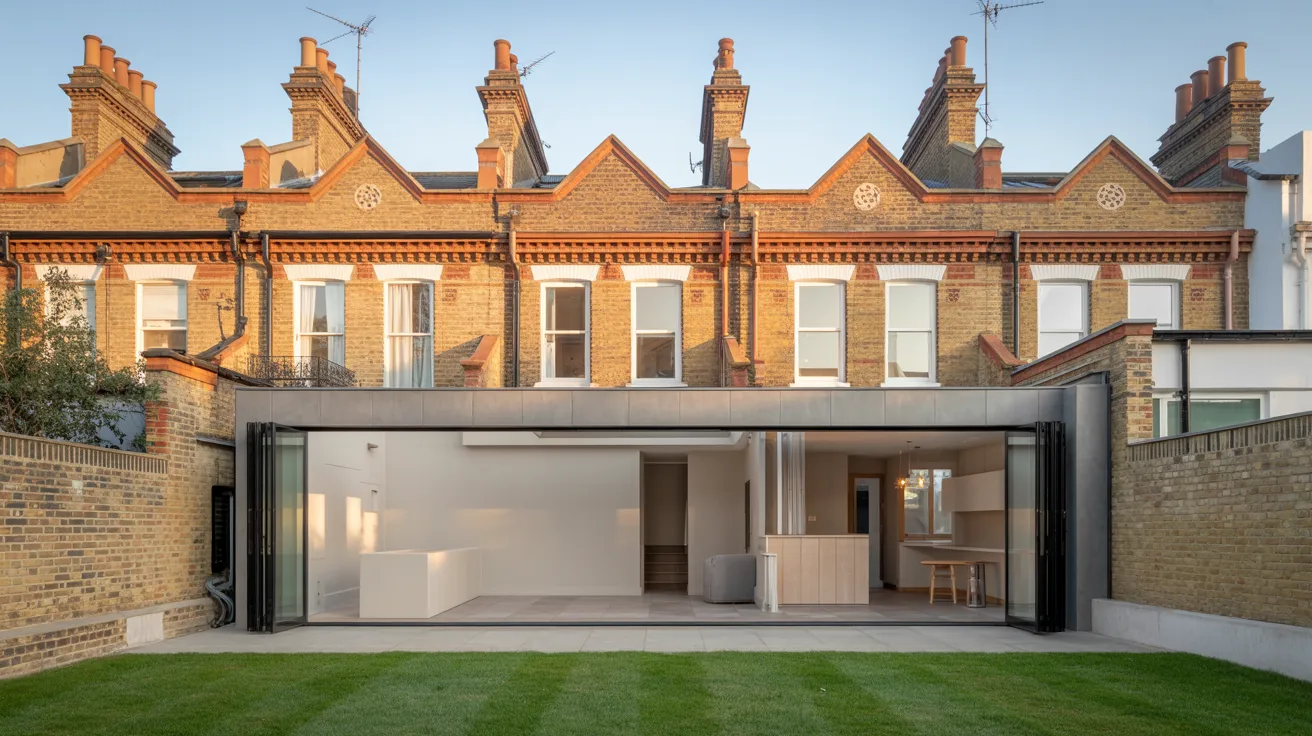
How a Two-Storey Extension Differs From a Single-Storey
A two-storey rear extension addresses two problems at once: the ground floor that is too small for family life, and the first floor that is one bedroom short of what the household needs. But its complexity — in planning, structure, and neighbour relations — is significantly greater than a single-storey addition.
Spatially, a two-storey extension adds both ground-floor and first-floor space. Typically, the ground floor becomes an enlarged kitchen-dining space, while the first floor adds a bedroom and bathroom above. This dual-level gain is why two-storey extensions are so desirable on space-constrained London terraces.
In planning terms, the permitted development rules are much more restrictive. A two-storey rear extension has a maximum depth of 3 metres from the original rear wall and must be at least 7 metres from the rear boundary — a combination that is rarely achievable on inner London properties where gardens are typically 8–15 metres deep. As a result, most two-storey rear extensions require full planning permission rather than permitted development.
Structurally, the complexity is much greater. Two sets of floor and ceiling structures, additional load paths to the foundations, and the need for a more substantial foundation specification make the structural engineer's role more demanding than in a single-storey scheme. The connection between the two levels, the opening in the original first-floor rear wall, and the junction with the existing structure all require careful design.
On neighbour impact, the effect is far more pronounced. A two-storey extension affects daylight, sunlight, and outlook on two floors of the adjacent properties — not just one. Planning officers scrutinise two-storey schemes much more closely, and the 45-degree rule (see Planning Rules section, below) becomes a more critical design constraint.
| Aspect | Single-Storey | Two-Storey |
|---|---|---|
| Typical planning route (terrace) | PD up to 3m; Prior Approval up to 6m | Full planning permission in almost all London cases |
| PD depth limit | 3m standard; 6m under Prior Approval | 3m — but must also be 7m from rear boundary. Rarely achievable in London |
| New floor area | Ground floor only | Ground + first floor — roughly double the footprint area |
| What you typically gain | Larger kitchen-diner; garden connection | Kitchen-diner below + bedroom and/or bathroom above |
| Structural complexity | Moderate — one floor structure, ground bearing | Higher — two floor structures, greater foundation load, first-floor opening |
| Party wall implications | One set of notices usually sufficient | More extensive — two levels of structural bearing, greater vibration impact |
| Neighbour impact | Ground-floor level only | Ground and first-floor — greater daylight, sunlight and outlook impact; more planning scrutiny |
| Conservation areas | Single-storey often achievable with good design | First-floor rear additions frequently refused or strongly discouraged |
Planning Rules for Two-Storey Rear Extensions in London
Two-storey rear extensions are theoretically permitted development under Schedule 2, Part A of the Town and Country Planning (General Permitted Development) (England) Order 2015. However, the conditions make PD almost impossible on London properties.
Permitted Development conditions: For a terraced or semi-detached house, a rear extension is PD if it is no more than 3 metres deep (measured from the original rear wall) and at least 7 metres from the rear boundary. For a two-storey extension, both conditions must be met. On inner London terraces where gardens are typically 8–15 metres deep, a 3-metre extension plus a 7-metre setback leaves only a 1–4 metre gap, which is not achievable. In practice, full planning permission is required for almost all two-storey rear extensions in London.
Full planning permission: When planning permission is needed, the application is assessed against a set of planning policy tests. These vary slightly by borough, but the core concerns are consistent.
Key planning tests: Planners assess the impact of the extension on neighbour amenity (daylight, sunlight, and outlook), the scale relative to the host building, and the design and materials. Character and appearance in the streetscene are less decisive for rear extensions because they are not visible from the public highway. Materials that match or reasonably complement the existing building — London stock brick, slate or tile roofing, compatible window proportions — will always be preferred to incongruous cladding or mismatched joinery.
The 45-degree rule: Many London boroughs apply a 45-degree test as an informal guide. The test works as follows: if a line drawn at 45 degrees from the nearest habitable-room window of an adjacent property — taking the sill height as the starting point — is intercepted by the proposed extension, the planner may raise a concern about overshadowing or loss of outlook. This is not an absolute rule and can be overridden by other design or policy factors, but understanding it helps calibrate the design. A lower first floor (perhaps with the first-floor windows set higher, or a shallow pitch roof that steps down toward the boundary) can help satisfy the test.
Conservation areas: Two-storey rear extensions in conservation areas require full planning permission and face a higher bar. Many borough conservation area guidance documents express a strong preference for no rear extension beyond the original building line at first-floor level. In effect, this means single-storey is often the maximum achievable in a conservation area, even if the planning policy might technically allow a two-storey scheme. It is essential to understand the conservation area guidance for your specific property before committing to a two-storey design.
Article 4 directions: Some London boroughs have issued Article 4 directions that remove permitted development rights for rear extensions in specific areas. Check your local planning portal to confirm whether an Article 4 direction applies to your property.
What Space a Two-Storey Extension Can Create
A two-storey rear extension creates both quantitative and qualitative spatial gains. A typical scheme — 3 metres deep and 4.5 metres wide — generates approximately 27 square metres of new floor area (13.5 per floor). This is enough to transform the use of the ground floor and add a second bedroom on the first floor.
Ground floor: The extension typically becomes a larger kitchen-dining space. A 3m deep × 4.5m wide ground floor (approximately 13.5 m²) can accommodate a dining table for six, a run of kitchen units, and good circulation. On Victorian terraces where the original kitchen is often only 3 metres wide and 2 metres deep (6 m²), the spatial transformation is dramatic. The ground-floor extension also allows the original rear room to be opened through as a single, flowing living space if the structural opening is designed to feel generous.
First floor: The first-floor addition typically creates one new bedroom or a bedroom-plus-en-suite configuration. A 3m deep × 4.5m wide bedroom (13.5 m²) is a good-sized double room. Alternatively, if the depth allows, the floor can be divided into a smaller bedroom (2.5m × 3.5m) and an ensuite bathroom or shower room. The exact configuration depends on the site geometry and whether the extension can connect directly to the existing first-floor landing.
Internal staircase: A critical design question is whether an internal staircase is needed. If the first floor of the extension connects directly to the existing first-floor landing through the original rear wall, no internal stair is required — the extension's first floor is simply accessed as a continuation of the landing. On many Victorian terraces where the extension sits behind the rear outrigger, this geometry works perfectly. However, if the extension is positioned such that the first floor cannot connect directly, an internal staircase within the extension footprint becomes necessary. This consumes approximately 3–4 m² of floor area on each level (the landing and stairwell) and must be accounted for in the plan. A compact open-riser staircase or a spiral stair can minimise the footprint, but the loss of usable floor area is real.
Structural Considerations
A two-storey rear extension has a significantly more complex structural profile than a single-storey addition. The structural engineer's specification will be more demanding and will typically specify deeper, heavier, or more sophisticated foundations, and a more robust connection to the existing structure.
Foundations: A two-storey extension carries the load of two floors. On Victorian terraces with shallow strip footings (often only 800–1200 mm deep), the existing foundation may not be adequate to support the additional load. The structural engineer will specify either deeper footings, wider footings, or — on poor ground — a reinforced concrete raft or piled foundation. The specification depends on the soil type (determined by a site investigation or party wall engineer's report) and the proximity to neighbouring foundations. If the extension is built close to a party wall, the party wall engineer may require underpinning or other protection measures to avoid settlement damage to the neighbour's building.
Ground-floor structure and first-floor slab: The ground floor of the extension typically has a reinforced concrete slab on a hardcore bed. The first floor of the extension requires a structural floor — either timber joists (typically 225–275 mm deep softwood joists, 400–600 mm centres) or a reinforced concrete beam-and-block floor. The choice depends on the span and the building system. Timber joists are lighter and cheaper; concrete is more robust and provides better acoustic isolation. Where the first floor needs to span more than about 4 metres without an intermediate bearing, a concrete specification is often preferred.
Rear structural opening: The original ground-floor rear wall must be opened to allow access into the new extension. This opening is spanned by a steel beam (typically an RSJ or Universal Beam, 200–300 mm deep depending on the span and load). At first-floor level, the original rear wall must also be modified — either opened (if a deep extension allows) or breached locally to allow access from the landing. The structural engineer will specify the beam and any local strengthening needed.
Bearing on the party wall: If the extension is built up against or very close to the party wall, the first-floor joists or beams will bear on or near the party wall. The structural engineer will detail the bearing point, and the party wall surveyor(s) will specify protection measures and conditions in the Party Wall Award. This is a key party wall matter and can add complexity to the construction process.
Steel frame vs. masonry: For a deep or heavy extension, the structural engineer may recommend a steel frame (a primary frame of Universal Columns and Beams, with brick cavity or block infill). Steel is more efficient for longer spans and heavier loads. However, steel frames are more expensive and require a certified steelwork contractor. For shallower extensions on typical London sites, a cavity masonry specification (load-bearing brickwork with a structural concrete floor) is usually adequate and more economical.
Party Wall Implications
A two-storey rear extension almost always triggers the Party Wall etc. Act 1996. This is one of the most important procedural requirements for any two-storey scheme and must not be overlooked.
Notices: Both neighbouring properties (left and right on a mid-terrace, or one on a semi) must be served with party wall notices at least two months before work begins. The notice must include a schedule of condition (photographic record of the adjacent properties) and a structural schedule specifying the works planned and any protection measures required. Serving notices late or incorrectly is a common source of disputes and delays.
First-floor bearing: At first-floor level, if the extension wall is built up against or very close to the party wall, the first-floor joists will bear on the party wall or nearby. The party wall engineer will assess the bearing capacity of the party wall and specify conditions in the Party Wall Award. These might include underpinning to local sections, temporary propping during construction, or a structural steel beam built into the party wall to distribute the load. The cost and complexity of these measures can be significant and should be anticipated in budget planning.
More extensive requirements: A two-storey extension typically generates more extensive party wall requirements than a single-storey addition. There are more bearing surfaces, more vibration during construction (particularly from pile-driving if piled foundations are needed), and greater potential for differential movement between the new and existing structures. An experienced party wall surveyor is essential.
For the full procedure, refer to the Party Wall Guide on this site. The key point to remember is that party wall notices must be served before work begins, and disputes with neighbours over party wall matters can delay projects by months.
The First-Floor Window Design Question
The design of first-floor windows on a rear extension is one of the most critical planning and neighbour-relations decisions. First-floor windows directly overlook neighbours' gardens, which is the single biggest neighbour concern in a dense London context.
Overlooking and privacy: A first-floor window that looks directly into a neighbour's garden or into an adjacent dwelling is a material planning concern. The planning test is not absolute — a small amount of overlooking is inevitable in London — but excessive or direct overlooking of private outdoor space or windows can result in refusal or conditions requiring mitigation.
Standard approach: The standard design response is to position windows on the side elevations (the walls adjacent to the party wall) as obscure-glazed or high-level (above 1.7 m from the floor), so that sightlines pass over the neighbour's garden rather than into it. Windows on the rear of the extension (the wall facing away from the adjacent properties, toward the owner's own garden) are less restricted because they do not overlook neighbours. Windows on the front of the extension (rare in a rear extension) would normally be obscure-glazed or high-level.
Setback from boundary: Most London planning officers expect at least 1 metre setback from the party wall at first-floor level. If the extension is built right up to the boundary, even with obscure glazing, the visual mass and dominance can be a concern. A 1 metre setback (so the extension is 1 m short of the party wall) reduces the perceived bulk and allows a small gap for light and air on the neighbour's side.
Balconies and Juliet balconies: Any raised platform, balcony, or Juliet balcony at first-floor level is very difficult to justify in a planning application, because it compounds the overlooking concern. A Juliet balcony (a balustrade with no actual floor overhang) is sometimes accepted, but a proper balcony is almost certainly to be refused unless the property is extremely isolated or the neighbour's garden is very deeply private. If a balcony is desired, it must be designed as part of the planning strategy from the outset — for example, with a high opaque screen or by limiting it to a corner of the extension where it does not overlook directly into the neighbour's space.
Conservation area guidance: Many London conservation area statements explicitly discourage first-floor rear additions or specify that they should be set well back from the original building line. Some conservation areas effectively limit rear extensions to single-storey on this basis. It is essential to read the conservation area guidance (available on your borough's website) before committing to a two-storey design. A conservation area statement might say, for example, "rear extensions should not extend beyond the existing building line at first-floor level" — which would rule out a two-storey scheme altogether.
Design Approach — Making a Two-Storey Extension Work
A two-storey rear extension has a much larger visual presence than a single-storey addition. It occupies a much larger envelope in three dimensions — height, width, and depth — and its visual impact on the character of the property and the street is more pronounced. Getting the design right is critical both to the planning case and to the long-term aesthetic of the home.
The external form: A two-storey rear extension can be resolved in two fundamentally different ways: as a clear contemporary contrast to the original building, or as a considered traditional addition that reads as an integral part of it.
Matching or contrasting: A traditional approach — using London stock brick, matching window proportions, slate or tile roofing, and mouldings that reference the original building — can make a two-storey extension read as an original part of the house from the garden view. This approach works particularly well on Victorian and Edwardian terraces where the extension becomes almost indistinguishable from the original. Conversely, a rendered or cladded contemporary addition — perhaps with a flat roof, large frameless windows, and a deliberately minimalist aesthetic — reads as a deliberate modern intervention. Both approaches can be excellent; neither is automatically appropriate. The choice depends on the character of the property, the planning context (some conservation areas favour traditional design; others are now open to sensitive contemporary work), and the owner's preference.
The roof junction: Where the extension roof meets the original rear elevation at first-floor level is a critical detail. If the extension has a flat roof and the original house has a pitched roof, the junction must be carefully resolved — typically with the flat roof set below the soffit of the pitched roof, or a slope introduced to the extension roof to integrate visually. Waterproofing at this junction is crucial: poor detailing leads to leaks at the party wall line. The visual expression of the junction — whether it is a clean line, a stepped line, or an integrated slope — should be explicit in the design drawings shown to the planning officer.
Width: Extending across the full width of the rear of the house — matching the width of the original building — almost always produces the most coherent result. A 4.5–6 metre wide extension (the typical width of a Victorian terrace) reads as a substantial but unified addition. A partial-width extension — for example, only 2 metres wide — can look awkward and incomplete unless it is deliberately set back from the full width or the remaining section of the original rear wall is resolved architecturally (for example, with a large glazed panel or a deliberately expressed structural frame). In most cases, full-width is preferable.
What to Check Before Starting the Design Process
Before approaching an architect or submitting a planning application, confirm several key facts about your property and neighbourhood:
Garden depth: Measure the distance from the original rear wall of the house to the rear boundary of the garden. If this distance is less than 10 metres, a two-storey permitted development extension is extremely unlikely to work (you would need 3m extension + 7m setback = 10m minimum). Full planning permission will almost certainly be needed. For gardens less than 8 metres deep, a two-storey extension may be difficult to accommodate without building almost to the rear boundary, which creates other problems (lack of private outdoor space, overlooking of the extension from the boundary).
Conservation area and Article 4 status: Check immediately whether your property is within a conservation area and whether a Article 4 direction has been issued by the local authority. This information is available on the local borough's planning portal (usually under "Check a property"). Conservation area designation can rule out a two-storey extension, or at least make it much more difficult. Do this check before incurring any design costs.
Neighbouring precedent: If adjoining or adjacent properties on similar terraced streets have been granted two-storey rear extensions in the last five years, this is useful evidence. You can search the local planning portal for granted permissions on similar properties. If a comparable scheme was approved, your application is more likely to succeed; if there are no precedents, or if previous applications were refused, this is a red flag.
Original building line at first floor: On many Victorian terraces, the original first-floor rear wall already projects behind the main two-storey facade (it sits above a Victorian single-storey rear addition or scullery). Understanding this existing geometry is essential before commissioning a design. If the first floor already extends to 3 metres behind the main house, a further two-storey extension may not be feasible. Obtain a survey of the existing property (or at minimum, accurate measurements) before proceeding.
Party wall position: Confirm the legal boundary of your property and the exact position of the party wall(s) with your conveyancing solicitor. The party wall is usually on the boundary line, but on some older terraces it may be offset slightly. Understanding the party wall position is essential before the structural engineer is appointed, as it affects foundation depths and bearing details.
"A two-storey rear extension solves two problems at once — the ground floor that is too small for family life, and the first floor that is one bedroom short of what the household needs. Getting the planning case right is the central challenge."
Two-Storey Rear Extension at a Glance
- Planning: Full permission required in almost all London cases; PD only where garden depth allows 7m setback
- PD depth limit: 3m from original rear wall (terraced/semi); must be 7m from rear boundary
- First-floor windows: Overlooking is the primary planning concern; side windows typically obscure-glazed
- Party wall: Act applies in almost all cases; notices required before work starts
- Conservation areas: First-floor rear additions often refused or restricted; check local guidance before designing